Showing posts with label Star Trek. Show all posts

Tuesday, August 9, 2022

Vin Scully and Nichelle Nichols – A Tribute


What's going on here?

If you've stopped by the blog over the past week or so, you noticed that it looked like someone dropped and broke it, and then couldn't figure out how to put it back together. That's not far from what actually happened. So until the old look gets sorted out, we've gone back to basics so I can keep posting, and you can keep reading without eye strain.  And at some point (I hope) we'll be back to normal. Until then, let's take a moment to celebrate two of the many wonderful people we've lost over the past week. 


In a 1964 episode of The Fugitive called “Man On a Spring,” Richard Kimble walks into a tavern, suitcase in hand as always, and on the television behind the bar is a Los Angeles Dodgers game being called by Vin Scully.


Scully was then in his 14th year as the Dodgers announcer, and he was just getting started. By the time he retired in 2016 he had spent 67 years in that vocation, a remarkable rarity in not just having the same job, but also to consistently perform it at the highest possible level. Perhaps his cadence did slow a bit in the last couple of years, but fans that tuned in and heard his familiar, reassuring voice still knew that for the next three hours they were in good hands. For baseball lovers, this was Comfort TV. 
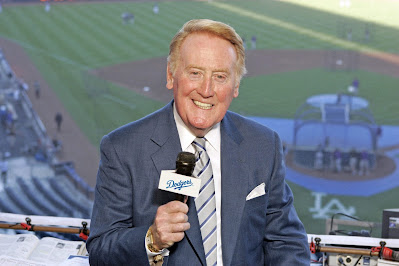


His eloquence as a storyteller was unmatched - he could recall moments from games he called decades earlier; he could slide in anecdotes from history or philosophy or popular culture - all without a script, and never miss a pitch call. There's a reason why fans would bring a radio to Dodger Stadium so they could still listen to Scully call the game they watched from the seats. 


If he had a signature call (outside of Sandy Koufax’s perfect game, which happened before most of us were old enough to listen), it would be of a hobbled Kirk Gibson’s game-winning home run in the 1988 World Series. In this unforgettable moment he said nothing while Gibson rounded the bases, letting the pictures speak for themselves. Only as the celebration began did he lend his trademark extemporaneous brilliance to the occasion: “In a year that has been so improbable, the impossible just happened.”


But this call was my favorite – short and sweet.


The big moments didn’t need his help - it was the little moments, the dull moments (frequent in baseball), in which Scully could hold a viewer’s interest like few other broadcasters before or since. His was an old school professionalism that is seemingly lost now, in a world in which calling attention to yourself is the path to more Instagram followers and that’s all that matters.


Which brings us to Nichelle Nichols. Yes, there is a parallel.


Obits and tributes described her as a trailblazer, which she surely was. What none of them said was how she blazed that trail, the credit for which belongs both to her and to Star Trek creator Gene Roddenberry. 
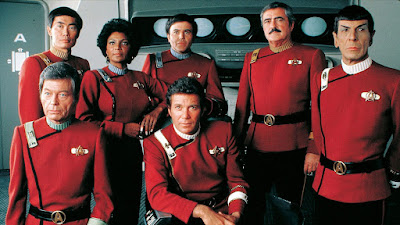


When viewers first met Lt. Nyota Uhura she was exactly where we’d become accustomed to seeing her – as a communications officer on the bridge of the Starship Enterprise, serving in a position of authority and often playing a critical role in the success of its missions.


The fact that the character was black likely did get some media attention at the time, but it was never emphasized on the show. Calling attention to it seemed silly, as the whole point of the series was to show how humanity had evolved in the era of interstellar travel.


In three seasons she was rarely a focal point of any episode. Sometimes she only had a handful of lines (“Hailing frequencies open”), and sometimes she didn’t have any. But her mere presence remained powerful, which is why Dr. Martin Luther King urged her to stick with the low-rated series despite her limited screen time.


And when she got something interesting to do, as in the alternate universe episode “Mirror, Mirror,” she was unforgettable. 
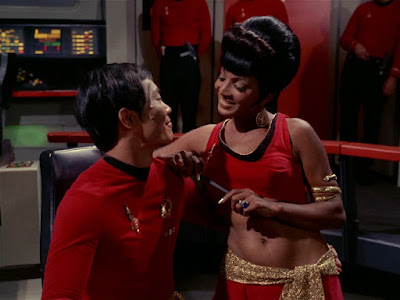


Lt. Uhura was a member of an elite crew on the flagship of the Starfleet armada. That alone commanded respect and admiration. We’ll never know how many young women – not all of them African-American – she inspired to dream bigger.


You don’t have to call attention to yourself to make an impact. Sometimes – most of the time – just doing your job well is more than enough.

Monday, August 23, 2021

Some Star Trek Fans are Never Happy


I like to keep the negativity to a minimum here, but the title of this piece seems to me an inescapable conclusion.


It’s not an indictment of all Star Trek fans, of course – only the most vocal. Science fiction always attracts a particularly passionate fanbase, but with that passion often comes demands that no television show could ever satisfy.


These thoughts were reinforced as I’ve been making my way through the original Star Trek series on blu-ray. 


It has become my habit, as it has on all the other Trek shows I’ve watched on disc, to follow each episode viewing with a visit to Jammer’s Reviews, the oldest Star Trek episode review site online (founded in 1995!). Following each review by founder Jamahl Epsicokhan, there is an active comments section where discussions about some episodes have been ongoing for more than ten years.


I haven’t done a count on the thousands of posts there, but in reading most of the threads, some more than once, I’d say the percentage of negative comments outpace the positive ones by at least a 4:1 margin.  


There are a handful of episodes from each Trek series that reverse that trend: “City on the Edge of Forever,” “Measure of a Man,” “The Inner Light,” “In the Pale Moonlight,” “Someone to Watch Over Me,” – but even these have their detractors. 


Even more surprising is how often Jamahl himself, aka Jammer, is one of Trek’s harshest critics.  He shares the elitist view of the most annoying ST fans who proclaim that Deep Space Nine can do no wrong, while Voyager and Enterprise could do nothing right. Eventually his visitors called him out on it. His response: “If I didn’t like (Star Trek) why would I spend all this time reviewing it?” That’s a good question, actually, but he did not provide an answer.


Again, I know this can’t be a representative sample of most Star Trek viewers. At least I certainly hope it’s not. What pleasure could someone get from watching any show the way the Washington Post watched Trump speeches, and then taking it as a personal insult when yet another episode didn’t rise to their lofty expectations?


I’ve only been to one Star Trek convention, and I do not recall ever being surrounded by hundreds of grumblers. There was real joy in the air, a sense of shared celebration that unites those in attendance regardless of their race, gender, etc. For that brief time, you could almost believe the dream of Gene Roddenberry had been realized, and that our future held the promise of better days.


No doubt even these colorfully costumed fans had episodes they liked more than others, but this was superseded by an appreciation for the franchise as a whole, of its philosophy and optimism and continuity, that was enough to sustain interest when a particular episode proves less than compelling.


That’s the way I watch Star Trek. I’m fascinated by so many of the elements that were there from the beginning, and how they have evolved through subsequent incarnations: the excitement of exploration into a limitless universe; the science and technology that enables interstellar travel; how the Prime Directive dictates how and when Starfleet acts on behalf of other species – and how often it is violated; how human beings living centuries ahead of us maintain an affection for what we revere now, whether it’s Picard’s preference for books over electronic readers, or Tom Paris’s fascination with 20th century automobiles.


So when I’m not engaged in the plot, I just look around the frame and find that’s enough to get my money’s worth. I wonder what those red and blue liquids are in the giant beakers in Dr. Crusher’s sickbay, what Romulan ale tastes like, and whether the 3D printers we have now are the first step toward every home having a repliactor. 


Surely, that’s a better use of one’s time with a show one supposedly likes, than always explaining in excruciating detail exactly how many ways a particular episode has failed.


This is not to say anyone shouldn’t express an opinion, even a negative one, about any TV show. I guess the message is, if someone really finds only one out of every four or five episodes of a series worth one’s time, why still be a fan? I have no interest in Discovery or Lower Decks or the J.J. Abrams reboot films, so just not watching them seems like a healthier option than watching and then attacking them online.


Even if the franchise cannot revive itself successfully anymore, Star Trek has already given us more than 600 one-hour episodes of thought-provoking television, and a few pretty good movies as well. Nothing else on television is likely to ever come close to that achievement. And it is one that deserves celebration. 


Monday, August 10, 2020

When Classic TV Meets Shakespeare


“We have seen better days,” is a quote from Shakespeare’s Timon of Athens that seems appropriate at the moment.


Comfort TV provides a welcome diversion from our everyday struggles, and sometimes delivers it’s own unique spin on the Shakespeare canon. Of course, there have been faithful adaptations of the actual plays that have appeared on television through the years, including a fine PBS series that covered just about all of them. But to include those here as well would make this a much longer blog, and brevity is the soul of wit (Hamlet, Act 2, Scene 2).


So let’s focus instead on those moments when Shakespeare was incorporated into a classic TV show plot, and what interesting variations were sometimes explored. And let’s start with the one indisputable classic among the attempts.


Moonlighting (1986)

“Atomic Shakespeare”

I had not watched this episode in a long time, and wondered how well it would hold up. Verdict: It’s as brilliant now as it was the first time I watched it – which was also the first time it aired. 


The show’s take on The Taming of the Shrew floors the accelerator in the first scene and never lets up – the quips (“A major plot point cometh”), the sight gags (Wall of Throwing Vases), the pop culture references (everything from The Carpenters to The Honeymooners), the songs, and the inside jokes come as quickly as they do in Airplane! and the Naked Gun films. It helps that Shakespeare’s play was a broad comedy to begin with – but the added dialogue blends so seamlessly with passages from the original play that at times it’s difficult to know which one is being spoken.


Amazingly, this was the lowest-rated episode of the series that season. Go figure.


Eight is Enough (1977)

“The Bard and the Bod”

Joanie lands the part of Titania, Queen of the Fairies, in a local production of A Midsummer Night’s Dream. Halfway through rehearsals, the director decides there should be a scene where all the fairies appear on stage naked. Now Joanie has two choices – should she stay with the play, and if she does should she tell her father?


We only get a few scenes from Shakespeare (Dick Van Patten reads the “What fools these mortals be” passage), but as with the best Eight is Enough episodes this one mixes comedy and drama with an expertise that few other shows can match.


The Adventures of Ozzie & Harriet (1954)

“An Evening With Hamlet”

David is studying Hamlet in school. Ricky doesn’t think much of the play, with all its talk about suicide and scenes of people roaming around graveyards: “It’s just not commercial.” When their TV conks out, Ozzie suggests they spend that evening reading the play as a family – and immediately regrets the decision when he’s later invited to a poker game. But the reading commences, and is joined by a stranger that knocks on the door looking for an address – turns out that stranger is an actor who has performed Shakespeare many times, and helps the Nelsons get into the spirit of the material. Like many of this show’s best episodes “An Evening With Hamlet,” is both slightly surreal and laugh-out-loud funny. John Carradine, who did play Hamlet on stage, is wonderful as the lost stranger. 


Fame (1982)

“The Strike”

The kids at the School for the Performing Arts are preparing to perform a musical version of Othello, but that production is threatened when the school’s teachers all go on strike.


So much to like in this typically strong first-season episode: Coco sulks because she loses the part of Desdemona to Julie, and wonders if she would have got it if she had been white – interesting to hear a colorblind casting debate before that became a hot button topic; Leroy, who has enough trouble with modern English, struggles with Shakespeare’s dialogue, to the point where he nearly quits the show. But Gene Anthony Ray nails the scene where Leroy finally gets it. And the performance of “Desdemona” is one of the most elaborate production numbers the show attempted to that date. 


Gilligan’s Island (1966)

“The Producer”

For me this is as good as Gilligan’s Island got, which is not exactly meant as a compliment. Phil Silvers guest starts as producer Harold Hecuba, just one of dozens of people who come and go from the island while the castaways can’t figure out how to leave. During his stay they stage a musical version of Hamlet.


If ever wanted to play’s famous soliloquy sung to the music of Bizet’s Carmen, here’s your chance. 


Happy Days (1974)

“A Star is Bored”

Richie convinces the Fonz to take on the lead role in Hamlet, in an episode that aired right around the time when Fonzie began his ascent to ‘70s icon. So while the formula that would carry the series for several more years begins to solidify, this second season show also offers some unexpectedly serious moments as well, as when Richie explains the meaning of “To be or not to be,” and Fonzie recalls moments after his father walked out when he pondered that same question. 


The Flintstones (1966)

“Curtain Call at Bedrock”

I could have included “Juliet is the Sun” from The Brady Bunch in this piece as well, but as that one was covered recently in another blog we’ll turn instead to Bedrock and a PTA production of “Romeorock and Julietstone.” Apparently Shakespeare has been around a lot longer than we all thought. Barney plays the lead but he’s no Harold Axelrod. Be warned that this is a Gazoo-era episode, so your interest may vary depending on which side you favor in that audience divide.


Star Trek (1966)

“The Conscience of the King”

Star Trek: The Next Generation incorporated several Shakespeare references and performances, no doubt to give Royal Shakespeare Company alumnus Patrick Stewart the chance to look even more awesome than he already did. But the original series offered the first glimpse of Shakespeare on a starship, when a traveling company of actors stages a performance on the Enterprise.


Scenes from both Macbeth and Hamlet are staged, while an investigation is launched into whether the company’s lead actor used to be a brutal dictator responsible for the execution of 8,000 people. As that unfolds, Kirk falls in love with the actor’s daughter (of course). The ending is a bit of a letdown, but this was an ambitious attempt to craft a tragedy in the style of Shakespeare against a backdrop of the Bard’s original plays.

Monday, November 19, 2018

Classic TV’s Most Unconvincing Indians


November means Thanksgiving, a time to remember that celebrated moment when Pilgrims and Indians shared a festive dinner table. Many of us first learned about the history and culture of Native Americans while studying Thanksgiving in elementary school. Hopefully those lessons were more accurate that what we learned from television during the Comfort TV era. 


I’m not going to condemn or defend the broad portrayals of Native-Americans in situation comedies. But I will say that when they were funny, I laughed. I don’t think that makes me a horrible person, but then we are rarely the best judges of our own characters.

There were a few (comparatively) earnest portrayals in this era as well, beginning with Jay Silverheels as Tonto on the classic Lone Ranger series. 


It helped that Silverheels was indeed Native-American – a Mohawk from Six Nations of the Grand River in Ohsweken, Canada. While he spoke in the broken English common to most Indians in film and TV westerns (“Him dead, kemo sabe”), there was also dignity in the character, and frequent acknowledgment that this “faithful Indian companion” was not a sidekick but a full partner in the Lone Ranger’s crime fighting exploits.

And then there was this guy:


Nearly 50 years later it is still a remarkably effective public service announcement, even if the crying Indian, billed as Iron Eyes Cody, was actually an Italian actor named Espera DeCorti. His work here belies the now common assertion that performers should always be the same ethnicity as the characters they play. Could anyone else have made that final image more heartrending?

I think I’d also have to put Ed Ames in the positive category, for his long-running portrayal of Mingo on Daniel Boone (and perhaps also for the most famous tomahawk throw in the history of television).


But enough praise – let’s get to those offensive but amusing stereotypes. Here are the nominees for classic TV’s most unconvincing Indians.

Bernie Kopell as Black Salmon
Petticoat Junction (1964)
In “The Umquaw Strip,” series villain Homer Bedloe discovers that the Cannonball passes through a stretch of land that was never legally acquired from the Indians. His scheme to shut down the railroad fails, but it does offer a chance to see Bernie Kopell, one of TV’s most prolific sitcom character actors, play a member of the Umquaw tribe (one who attended Harvard Business School).

Don Rickles as Bald Eagle
F Troop (1965)
If any series specialized in the type of Native American ethnic humor that typified this gleefully unenlightened era, it’s F Troop.


As if Frank DeKova’s recurring role as Chief Wild Eagle was not enough, the show featured a succession of guest stars who joined the tribe for some equally inappropriate banter, none more memorable than Don Rickles in “The Return of Bald Eagle.”  Rickles is totally unhinged as Wild Eagle’s soldier-hating son. 


Don Adams as Running Creek
Get Smart (1965)
A rogue band of Indians called the Red Feathers demand the return of their stolen land, or they’ll unleash a powerful new weapon. Max infiltrates the tribe and winds up engaged to the chief’s daughter. Of course Agent 86 in buckskins is funny, but “Washington 4, Redskins 3” also unveils one of the funniest sight gags in the history of television. The first time I saw it, I thought I’d never stop laughing. 


Edward Everett Horton as Chief Screaming Chicken
Batman (1966)
The plot of “An Egg Grows in Gotham” is strikingly similar to the Petticoat Junction episode with Bernie Kopell: Arch-criminal Egghead (Vincent Price) finds a technicality that would revert ownership of Gotham City to the Mohicans, now led by Chief Screaming Chicken. Edward Everett Horton steals every scene he’s in with the sort of lines you couldn’t say now without getting in trouble: “Indian poor businessman, my cousin, he sell Manhattan for 24 dollars, could have got 35!”


Burt Reynolds at John Hawk
Hawk (1966)
We’re told that John Hawk, detective with the New York District Attorney’s office, is a full-blooded Iroquois, but that just seems like something this short-lived series came up with to make a standard character more exotic. It’s also a role entirely unsuited to the charismatic Burt Reynolds. The stoic Hawk rarely cracks a smile and speaks in a slightly clipped monotone – like an urban Tonto. It’s a well-shot series that still has its supporters, judging from the high IMDB episode ratings, but Reynolds wasn’t one of them. It was a frequent target of his self-deprecating Tonight Show appearances. If you’re curious, check out the first episode, which features Gene Hackman as a Bible-quoting psychotic killer. 


Raymond Bailey as “Chief” Drysdale
Beverly Hillbillies (1967)
As in Petticoat Junction, another Paul Henning series, we have a white man impersonating an Indian to make a few bucks. Co-written by Henning, “The Indians are Coming” opens with the Clampetts learning about a minor border issue between their oil-rich land and the adjoining Crowfeet Indian reservation. At the bank, Mr. Drysdale is roused by the news: 

“They hit a gusher there! Send a message to my red brothers – Milburn Drysdale speak with straight tongue…send all black wampum my bank, we put in solid steel teepee.”

Miss Jane: “No…there’s been a boundary dispute and the Indians are claiming part of the Clampett oil land.”

Drysdale: “Why those dirty, thieving savages!”

The tribal representatives, Chief Running Wolf and his son, are cultured 20th century men who arrive at the bank to find Drysdale in full buckskins, spouting every Indian cliché from every western movie. The Chief and his son play along, letting him embarrass himself further. 

Willliam Shatner as Kir-ok
Star Trek (1968)
“The Paradise Syndrome” is not quite as bad as “Spock’s Brain” and “The Way to Eden,” but it dwells in the same rundown neighborhood of questionable third-season episodes. The Enterprise visits a planet populated by a tribe that resembles the Native-Americans from earth’s history. Kirk joins the tribe after his memory is wiped, and is soon being worshipped as the great healer, the only brave worthy of marrying the lovely Indian priestess Miramanee. It’s all a bit silly but William Shatner gives it everything he’s got and then some, as he always did to help sell a substandard script. 


Sunday, May 24, 2015

In Defense of “Spock’s Brain”

 
Note: This review is part of the 2015 Summer of MeTV Classic TV Blogathon hosted by the Classic TV Blog Association. Click here to check out this blogathon's complete schedule.


Writing about the original Star Trek in 2015 is like writing about The Beatles or The Wizard of Oz or sunlight. Everybody knows what it is, thousands of other people have already written about it, and at this point there doesn’t seem much left to add.

So rather than offer yet another tribute to the vision of Gene Roddenberry, or more praise for the show’s forward-thinking philosophy on race and class and technological achievement, and its optimistic view of mankind’s future, I thought it would be a more interesting challenge to find something praiseworthy in what is regarded by fans as the series’ worst episode. 


That would be “Spock’s Brain,” the show that kicked off Star Trek’s third and final season. "Frankly during the entire shooting of that episode, I was embarrassed," was Leonard Nimoy’s recollection. And if you’ve heard his singing on “The Ballad of Bilbo Baggins,” you know he doesn’t embarrass easily. Was it justified? Let’s find out.

Our story begins with the Enterprise approaching a mysterious alien craft. Before Captain Kirk can inquire if there might be any attractive young women aboard, one actually beams over, incapacitates the crew and then walks over to Spock and begins stroking his forehead. 


Sometime later the crew wakes up. Spock has been moved to sickbay where a solemn Dr. McCoy informs the captain, “His brain is gone.”

“If it was taken out, it can be put back in.” Kirk responds, showing the quick thinking that made him a Captain.  But McCoy warns that the procedure must be performed within 24 hours. Because, apparently, a body can’t survive without a brain for more than a day, unless it belongs to a Kardashian.

Thus begins the quest to reunite Spock’s brain with the rest of him, which requires the crew to beam down to a planet populated by cavemen wearing fuzzy blue skirts.

Sound ridiculous? Absolutely. But the next time this episode airs on MeTV and you’re tempted to change the channel, here are five reasons why “Spock’s Brain” is worth your time.

1. Marj Dusay
Before spending two decades on various daytime dramas, Marj Dusay was a frequent and always welcome guest star on many 1960s series like Get Smart, Hogan’s Heroes and The Wild, Wild West. She specialized in seductive brunettes who try to lead good men astray. Removing someone’s brain is going to rather extreme lengths, but it does fit the pattern. As Kara, the woman who makes Spock an involuntary organ donor, Dusay also gets to deliver the episode’s most memorable and inscrutable line: “Brain and brain – what is brain!”


2. William Shatner Gives 110%
Every Trekker has his (or her) William Shatner-as-Kirk impression, complete with convulsive body movements, random pauses between words and other assorted histrionics. The thing is, you don’t see that Shatner in “The Space Seed” or “City on the Edge of Forever,” when the story could stand on its own merits. It was only when the script was lacking that he would try to forcibly inject some drama into substandard material. So when Uhura asks Kirk why someone would steal a brain, Kirk responds, “Yes…why…would…they…want it?” “Spock’s Brain” needs all the help it can get, and Shatner is happy to oblige. 

3. It Makes a Perfect Drinking Game
As classic TV drinking games go, it’s hard to top the one for The Bob Newhart Show, in which participants drink every time a character utters the phrase “Hi Bob!” “Spock’s Brain” offers a variation on that theme: Count the number of times “Spock’s brain” is said by Kirk, McCoy and Uhura. If you’re drinking anything alcoholic, you’ll certainly start enjoying the show at some point.

4. The Sitcom Fadeout
Rarely does a Star Trek moment seem appropriate for a laugh track, but one certainly seems to be missing from the denouement of “Spock’s Brain.” After Dr. McCoy’s brain replacement surgery is successful, Spock immediately starts spouting dry scientific observations about the planet’s natives. “I knew it,” McCoy sighs. “I knew I shouldn’t have reconnected his mouth.” 


5. It’s Still Better than “Threshold”
The reign of “Spock’s Brain” as the worst moment in Star Trek history ended in 1995. That’s when Voyager released “Threshold,” in which Captain Janeway and Tom Paris were turned into salamanders and had reptile babies. After that, this episode seems almost quaint in its silliness.

And here is one bonus reason to stay tuned: even substandard Star Trek is better than any episode of Dating Naked, Honey Boo Boo, The Real Housewives of Lompoc and much of today’s television, for which brains are also optional. 


Monday, September 30, 2013

Comfort TV Goes Back to the Future

 
It is in our nature to wonder about the future. What will we be able to do in 20 or 50 years that we can’t do now? How will society change? How will technology evolve? 

So it’s not surprising that these speculations often found their way into television, obviously within the science fiction genre but also in comedies, dramas and animated series. One of the more fascinating aspects of watching classic television is looking at how the future was viewed by the shows of the past, now that that “future” has come and gone. 


How was the brave new world of the 1980s envisioned by people in the 1950s? There was an episode of The Donna Reed Show called “Explorers Ten,” in which Jeff and his friends form a club to talk about space exploration. A college astronomy professor tells the group that man will soon land on the moon, but there is a good chance that in their lifetimes the teenagers of the club will not just walk on the moon, they might visit Mars and Venus as well. Apparently they were pretty optimistic in the 1950s and early ‘60s. Hopefully that professor never got tenure.

Whenever a television series tried to depict the future, the two areas they always guessed on – and always got wrong – were couture and computers.

Why were the television writers of 50-60 years ago so certain that future generations would all want to dress in identical pajamas or one-piece jumpsuits? We’ve lost a lot of occupations to progress – gas station attendants, switchboard operators, milkmen – but fashion designer has not been one of them.


Computers have been around as long as television, and many accurately predicted they would become more sophisticated. But the assumption was always that they would have to be bigger to do so. Whenever you see a computer in a comfort TV series, it will always be an enormous floor model with a lot of blinking lights and two large spinning reels at the top. And if a character on the show asks the computer a question, it will respond either with a hokey electronic voice, made by an actor pinching his nose when he talks, or with a card that drops out of a slot after a cacophony of beeps like we used to hear on Mattel Electronic Football.


In retrospect, it is surprising that no one associated computer technology advancement with machines that would become smaller.

The sole exception to television’s poor track record at prognostication was Star Trek. The original Enterprise crew used communicators that resemble the cell phones we use now, and the diagnostic medical beds in Dr. McCoy’s sickbay have also been developed. On Star Trek: The Next Generation you will often see characters carrying communication tablets that perform many of the same functions our iPads do. With the advances now being made in 3D printing, even replicators may become reality.


Star Trek, of course, is the dream of what our future might look like. The nightmare can be experienced in any number of post-apocalyptic series, from Ark II and Planet of the Apes to Jericho and Revolution. And if you look at any list of shows set in the future, there doesn’t seem to be a lot of middle ground. We will either live in a futuristic fantasy world like The Jetsons, or be foraging for scraps in a primitive wasteland.

Neither one has happened yet. And given our genius for invention and our genius for stupidity, the future could still go either way. But look on the bright side – even if we find ourselves in the worst case scenario described in Ark II, at least we’ll have jet packs and chimpanzee scientists – not the worst tradeoff for Armageddon.  


Monday, July 2, 2012

Comfort TV Marathon: Ringing in the Fourth

  
At Comfort TV any holiday is a reason to settle back with some appropriately themed classic television episodes, and Independence Day is no exception.

Here are five patriotic shows to help ring in the Fourth of July. Just make sure to crank up the volume so you can hear the dialogue over any bombs bursting in air.

Bewitched
“My Friend Ben” and “Samantha for the Defense”
A standard Bewitched set-up – Aunt Clara tries to summon an electrician but zaps up Benjamin Franklin instead – is elevated into the series’ best two-part outing on the strength of its shrewd scripts and guest star Fredd Wayne. Wayne takes a gimmick and gives it real depth – he captures Franklin’s wit and principles as well as the scientific curiosity and wonder you’d expect to see in an enlightened man suddenly transported 200 years into the future.

Wayne’s performance as Franklin was so convincing that he would play the character again in episodes of Daniel Boone, Voyagers! and Simon and Simon, as well as in award-winning audio recordings of Franklin biographies. Plus, he’s a lot more convincing as a Founding Father than Bert Convy’s season 7 appearance as Paul Revere.

The highlight, for me, is the courtroom trial in “Samantha for the Defense,” in which Franklin must convince a judge that he is who he says he is, against all logic. It’s like a July 4 version of Miracle on 34th Street. Some interesting cameos in these shows as well from Paul Sand and famed disc jockey The Real Don Steele. 


Star Trek
“The Omega Glory”
This is a season 2 episode of the Original Series that foreshadows the sillier stories that became too commonplace in Trek’s final season. However, it is redeemed by a gloriously over-the-top moment near the climax, when Captain Kirk recites the Preamble to the US Constitution, with all the crazy cadences and random pauses and staccato gesticulations that have made William Shatner a television legend. I wonder if he memorized it from Schoolhouse Rock like the rest of us?


Family Ties
“Philadelphia Story”
A feverish Alex falls asleep while writing a term paper on the signing of the Declaration of Independence, and dreams about helping Thomas Jefferson find the self-confidence to write that historic document. Some very funny lines in the writing scenes, as Alex tries to coach Jefferson (played by Keaton dad Michael Gross), without feeding him the right words in advance. “Okay, let’s sign this baby and ship it off to England!”

The Brady Bunch
“Everyone Can’t Be George Washington”
For a Brady fan, any episode can produce a warm and fuzzy glow of nostalgia. But most of the shows that are still pretty funny are the ones featuring Peter: there's “The Personality Kid,” with the pork chops and applesauce bit, and “The Private Ear,” where Pete bugs his siblings’ rooms. To that list I’ll add “Everyone Can’t Be George Washington,” in which Peter auditions to play the Father of Our Country in a school play, and is cast instead as Benedict Arnold. The best moments are at the dress rehearsal, especially when Benedict’s wife Peggy, played by Florence Henderson’s daughter, Barbara Bernstein, pulls out Arnold’s old army uniform. 


Father Knows Best
“24 Hours in Tyrantland”
Now this - this is a remarkable piece of history, shot in 1959 but never aired on television – nor was it intended to. It was commissioned by the US Treasury Department as a warning against the dangers of totalitarianism, and played for years in schools and churches across America.

The story has Jim Anderson – the ever-stalwart Robert Young – trying to get his family to join him in a campaign to sell US Savings Bonds. The kids basically blow him off, saying that bonds might be a good investment but all that patriotic stuff is rah-rah nonsense. Jim, desperate to teach them that bonds preserve the American way of life, proposes a challenge – to see if they can survive 24 hours under a dictatorship – with good old dad as the dictator.

The kids go along and Jim gives them the full treatment; hard labor, unfair working conditions, and severe punishment for trying to escape. “If our young people don’t think enough of our way of life to try to preserve it,” he tells his wife Margaret, “I shudder to think what’s going to happen to America.”

Whether you embrace the message as powerful and patriotic, or dismiss it as the kind of anti-Communist propaganda that produced McCarthyism, “24 Hours in Tyrantland” offers a fascinating insight into life in 1950s middle America.