Showing posts with label Family Ties. Show all posts

Wednesday, February 2, 2022

One Night, Two Dates: The Classic TV Teen Dilemma


When I was in high school, having two dates scheduled for the same night was the kind of dilemma with which I never had to contend. Just trying to get one date was challenge enough. But the kids on Comfort TV shows were better looking and more popular, so it’s not surprising that this situation occurs in more than one classic show. 


How do they get themselves into these messes, and how did they handle it? Let’s find out. For each show, our double-date protagonist has been given a rating of 1-10 on the two-timer scale: a one means they’re relatively blameless; a 10 means they definitely need a stern talking-to from mom and dad.


“The Rivals”

Father Knows Best

Poor Betty Anderson has fallen into a rut in her relationship with reliable old Ralph. Her flirty friend Marge (played by Barbara Eden!) is always flitting between a half dozen steady boyfriends and telling Betty how lucky she is that no other boys are interested in her. 


She probably meant that as a compliment.


But when they’re doubling at a diner one Saturday night Betty runs into Doyle Hobbs, who she met last summer while briefly working as an engineer on a survey crew (in an episode aired the previous season - a rare bit on continuity for this series). 


So to prove to Marge she can land another guy she accepts a date to a concert in the park – even though she already agreed to go with Ralph.


What makes “The Rivals” such a fun episode is how Betty’s parents react to her dilemma. Jim is disappointed that his daughter would be so devious, while Margaret thinks every girl should occasionally get to enjoy that kind of adoring attention. But while Betty decides how to resolve the situation, Doyle stops for gas where Ralph works and they get to talking about Saturday. The final scene is as unexpected as it is delightful.


Lots of star power in this episode: In addition to Barbara Eden, Doyle is played by Roger Smith, later of 77 Sunset Strip.


Two-Timer Ranking: 8


The impulse to impress Marge is understandable, but not resolving the situation, even on the day of the date, cannot be excused.


“Mary’s Double Date”

The Donna Reed Show

The day before the Junior Prom, Mary Stone has a decision to make: “Whether to let Phil take me or Ernie.” She plays them off each other like a symphony conductor, while simultaneously avoiding a third suitor, Charlie, whom she affectionately describes as her “door mat.”


She gets asked by both her choices, as expected, and doesn’t plan to let the loser know until 5pm on the day of the dance. But her comeuppance arrives before then, swift and severe and well deserved. “You played a dangerous game, and you lost,” Donna tells her, gently, “so no tears.” 


Two-Timer Ranking: 9


This episode is pure magic. Wonderfully written and endlessly quotable: “It’s wonderful to be attractive and popular, but you have to learn to use that power gently, and with kindness.” Its been nearly 40 years since I was in high school, and I still recall the names and faces of a couple of queen bees who failed to heed that advice. And some of those moments still sting.


“The Subject Was Noses”

The Brady Bunch

Marcia gets starry-eyed when big man on campus Doug Simpson asks for a date on Saturday night – then remembers she already has a date for Saturday with “plain, sweet, ordinary” Charlie. 


Predictably, like Molly Ringwald in Pretty in Pink she decides to stick with the handsome popular boy over his undersized rival. But unlike Betty Anderson and Mary Stone she at least has the good sense to not let the situation linger until the weekend. Greg offers sage advice – break the date with Charlie by using the lame but surprisingly effective excuse of “Something suddenly came up.” And it works, until karma arrives in the shape of a football that hits her in the face.


“The Subject Was Noses” certainly ranks as one of the most memorable series episodes, especially in how the tables are turned against Marcia when her same date-breaking excuse is used against her.


Two-Timer Ranking: 4


Marcia not only lets Charlie down easy, she apologizes for her deception and learns her lesson.


“Double Trouble”

The Partridge Family

Keith tries to get a date with gorgeous Joanna Hauser, aka “Miss Everything,” but she’s already going to the big beach party with her steady, who goes by the name “Spider.” Laurie offers to set him up with bookish Sally Winkler from the Shakespeare club. Keith reluctantly agrees, and then Spider’s plans change so Joanna is available again. Now he has two dates, but only wants one of them. “So what’s the problem?” Reuben asks. “Dump the nice one and go with the knockout!” No wonder he’s still single.


Instead, Keith fakes a cold to let Sally down easy – but fate has other plans.


Two-Timer Ranking: 2


Technically, Joanna became available before Laurie told Sally about the party, so he never should have been stuck with two dates in the first place. And while pretending to be sick is a pretty gutless solution, Joanna Hauser is played by Cheryl Ladd, so desperate measures in this case are more admissible. 


“Who’s Crazy Here?”

Eight is Enough


Tommy likes both Gretchen and Sherry, so he dates them both at the same time. “Don’t say I didn’t warn you,” cautions older brother David.


This is the B-story of the episode, so it doesn’t get as much screen time as Tom’s bout with insomnia and the misunderstandings it triggers.


Two-Timer Ranking: 6


Tommy avoids direct conflict by scheduling one date for 8pm and the other for 10pm, so here we have a case of breaking the spirit of the law more than the letter. But to expect two girls that attend the same high school to never figure out what’s happening explains why Tommy was never considered Honor Society material.


“Double Date”

Family Ties


Like Keith Partridge, Alex Keaton is turned down when he asks his dream girl to the senior prom, and then asks another girl instead. But then the first girl becomes available, and he decides to keep both dates. He devises a plan with the help of his friend Skippy:


Alex: “Okay, let's go over the plan once more. Now, the north end of the gym is now called...”


Skippy:  “Area "A".”


Alex: “Okay. At no point is Rachel to enter area "A" - prior to 8:57. Now - areas "B" and "D" are free zones which means... Either girl may enter provided the band is not on a break at the time. Now remember, when I'm with Rachel, I'm gonna be wearing the blue boutonniere. When I'm with Jocelyn - the red one. There are emergency exits at either end of the gymnasium. The master switch box is behind the blue wrestling mat. This will allow you to switch off the lights, lower the backboards, and in case of an emergency, open the floor over the swimming pool. Let's hope it doesn't come to that. 


Two-Timer Ranking: 10


“We’re going to make history,” Alex tells Skippy, but of course his arrogance proves his undoing. The dates in question were played by Jami Gertz and Daphne Zuniga, making this episode about as classic 1980s as you can get.


Monday, March 9, 2015

Classic TV Two-Part Episodes: Hits and Misses

 
Theoretically the two-part episode is an option that should be utilized only in conjunction with a major milestone in a series (births, deaths, new character introductions, weddings, big name guest star) or when a writer comes up with an idea that is so good, it deserves a little extra breathing room to be fully explored.

But think back over the hundreds of two-parters presented in the Comfort TV era – how many of them really needed more time to tell their stories?

Having conducted my own informal study, I would say the results are about 50/50. Too often, these shows were a marketing ploy to leverage the built-in ‘event’ status afforded to super-sized episodes. That’s why they were used so often to open or close a season.

When there is legitimate reason for a “continued next week” freeze-frame, the result is often one of the most memorable moments in a series – think “The Menagerie” on Star Trek, “Fearless Fonzarelli” on Happy Days or “Carnival of Thrills” on The Dukes of Hazzard.

And when there is not enough content to justify a second episode, we’re left with a story that might have worked as a single show, padded and stretched to fill out a longer running time.

This is a big topic and one that may be revisited in a future blog, but for now here are five examples of when TV got it right – and five underwhelming misses.

Good: Family Ties: “The Real Thing”
Alex Keaton had no shortage of girlfriends in the first three seasons of Family Ties, but when he meets Ellen Reed early in season four, the show wanted to make sure we knew this was going to be different. Their opposites-attract romance, bolstered by the strains of Billy Vera’s “At This Moment,” was a major turning point for Alex and for Michael J. Fox, who is still married to the girl that played Ellen, Tracy Pollan. 


Bad: Charlie’s Angels: “Terror on Skis”
A typical Angels plot – protect a government agent from foreign radicals – is hampered by scene after scene of monotonous stock footage of people skiing during the day, at night, and in freestyle competitions. I had a little inside information on this one, having interviewed the episode’s writer, Ed Lakso, for my Charlie’s Angels book. He readily confessed to padding out the story to justify a location shoot in Vail, Colorado, because his wife wanted to go skiing. 


Good: The Dick Van Dyke Show: “I Am My Brother’s Keeper/The Sleeping Brother”
These episodes introduced Dick Van Dyke’s brother Jerry, playing Rob Petrie’s brother, Stacy. The bizarre plot has Stacy trying to break into show business but only being able to perform while he’s asleep (due to a rare, advanced form of sleepwalking). Despite that contrivance the shows are smart and funny, particularly during the cast performances at those Bonnie Meadow Rd. house parties that always made the suburbs looks so cool and sophisticated. 

Bad: Eight is Enough: “And Baby Makes Nine”
Flashbacks are a convenient way to stretch a story, but no two episodes abused that privilege more than the Season 5 opener of Eight is Enough. The saga of Susan’s difficult delivery of her baby not only offers numerous looks back at her romance with and marriage to Merle, it also reprises scenes that aired just ten minutes earlier in the same episode. Why not just play the theme song again while you’re at it?

Good: Get Smart: “A Man Called Smart”
The only thing tougher to pull off than a great two-part episode? A great three-part episode. But the laughs never fizzle in “A Man Called Smart,” an adventure originally conceived for theatrical release but re-cut for the series. One physical comedy sequence with a stretcher and a revolving door is as funny as anything that’s ever been on television. 


Bad: Mission: Impossible: “The Contender”
For all its many outstanding qualities, M:I never got a two-part episode right. I chose “The Contender” because the plot was particularly weak – capturing a guy who fixes prize fights seems beneath the IMF – but I also could have gone with “The Slave” or “The Council” or “The Controllers.” Viewers were accustomed to seeing the team solve any problem in an hour, and writers could never dream up any good reason for some missions to take longer.

Good: The Bionic Woman: “Doomsday is Tomorrow”
Where Mission: Impossible struggled with the two-part format, The Bionic Woman flourished. From the irresistible “Fembots in Las Vegas” to “Deadly Ringer,” the shows that earned Lindsay Wagner an Emmy, the series was always at its best with multi-episode storylines. My favorite is “Doomsday is Tomorrow,” in which Jaime must figure out how to shut off a computerized weapon (with a HAL 9000 voice) capable of destroying all life on earth. 


Bad: The Facts of Life: “Teenage Marriage”
So many shows have built two-part episodes around potential crises that cannot possibly come to pass, lest it mean the end of the series. Here, Mrs. Garrett and the Eastland girls try to prevent Jo from marrying her boyfriend. Had Nancy McKeon announced she was leaving the show, we might have bought into the conflict; but this was her first season, and we all knew she wasn’t going anywhere, extra episode or not.

Good: Little House on the Prairie: “I’ll Be Waving as You Drive Away”
The Ingalls family face their darkest hour when Mary loses her sight after a bout with scarlet fever. The scene where Charles must tell his daughter the diagnosis, while barely able to control his own heartbreak, is devastating. Mary attends a school for the blind, where she gradually comes to terms with her fate in a hopeful finale.  


Bad: Laverne & Shirley: “The Festival”
When a two-part episode is inspired by a road trip, it helps if we actually see the characters go somewhere. Here, Laverne, Shirley, Lenny, Squiggy, Frank and Edna all “travel” from Milwaukee to New York, but all they really do is visit a different part of the studio backlot. Not much fun to be had, unless you enjoy watching Penny Marshall climb a greased metal pole.

Wednesday, August 13, 2014

The Comfort TV Career of Meredith Baxter

 
The Internet Movie Database lists more than 100 credits for Meredith Baxter; 90 of them are for television. Her career began in an era when TV stars rarely crossed into film, but even after such transitions became commonplace she apparently had no such aspirations.  Next month, she joins the cast of The Young and the Restless.

I decided to write about her because I don’t think enough people do. 


Some TV actors are taken for granted, perhaps because consistent proficiency in a wide range of projects is not as esteemed as a single transcendent character or performance. Meredith Baxter starred in one of television’s best dramas and one of its best-loved situation comedies, appeared as a regular or recurring character in three other shows, earned four Emmy nominations and headlined enough TV movies for a Lifetime network marathon that would last a week.

Whatever she was in, she made it better, and that’s something you can’t say about a lot of performers with higher-profile careers. That’s why I’ve channeled my inner Ralph Edwards to celebrate her television achievements – This is Your Comfort TV Life, Meredith Baxter.

Her first year with professional credits – 1971 – includes a memorable appearance on The Partridge Family, in the season 2 episode “Where Do Mermaids Go?” In one of her rare screen performances as a brunette, Baxter plays a bohemian heiress, whom the Partridges first meet when she is skinny-dipping in a rural pond (talk about making an entrance!). In return for the family’s kindness, she deposits one million dollars in their bank account. 


Hippie characters in this era of television were usually played somewhat broadly, with a lot of now-archaic slang. Baxter brings a grounded, melancholy, mature-beyond-her-years quality to an often-clichéd role. And in her close-ups, you may be entranced as I was by the most stunning blue eyes of anyone on TV, with the possible exception of Lara Parker from Dark Shadows.

Just one year later she was headlining her own series, one created by Partridge Family creator Bernard Slade. Baxter played Bridget Teresa Mary Colleen Fitzgerald, an Irish Catholic school teacher who falls in love at first sight with cab driver Bernie Steinberg. “I think we have a problem,” they realize, and that was the introduction to Bridget Loves Bernie (1972-1973).

The couple’s inter-religious marriage and the culture clash of their respective in-laws was the launching point for many of the episodes, but the topics were not explored with the frankness and harder edge of All in the Family, which debuted the previous year. Instead, Bridget Loves Bernie was a sweet and gentle sitcom that worked because of the chemistry between Baxter and costar David Birney, whom she married (and later divorced).    


Despite being ranked fifth in the ratings among all shows that season, CBS shut it down out of concern over adverse reactions from a vocal minority of intolerant viewers. More than 40 years later it’s still the highest-rated TV series to be canceled. Not one of television’s prouder moments.

Following guest appearances on Barnaby Jones, Medical Center and Police Woman, as well as leads in several TV movies (one of the best being The Night That Panicked America, a dramatization of Orson Welles’ War of the Worlds), Baxter played Meg in a miniseries adaptation of Little Women, featuring Greer Garson, Dorothy McGuire and a cast rich in classic TV stars, from Susan Dey and Eve Plumb to William Shatner and Robert Young.

But it was her next series, Family (1976-1980), that for me still resonates most amidst her remarkable resume. Meredith Baxter joined the show in season 2, taking over the role of Nancy Maitland from Elayne Heilveil. 


Family is one of the best shows of the ‘70s and its not accessible anywhere now, outside of a discontinued DVD release of the first two seasons. Maybe we’ve lost the capacity to appreciate shows like this. After 20 years of sensationalized reality TV, the idea of dramatizing the normal low-key reality of life with one Pasadena family now seems like an incomplete pitch; what’s the hook? Is the father psychic or is the mother leading a double life? Does the son have super powers? Is the daughter a Muslim or a pop singer or something else that will bring in a broader demographic?

When the writing and the acting are as perfect as they are here, no other incentive should be necessary. To watch Family is to be wholly drawn into the joys and sorrows and relationships of fictional characters, and to believe that every word they say is extemporaneous, and could not possibly have been typed by someone else months earlier.

And to think we’ve come this far without even mentioning Family Ties (1982-1989), the show for which the actress is certainly best-known. Baxter was top-billed but quickly ceded the spotlight to Michael J. Fox, who Arthur Fonzarelli-ed the rest of the cast into supporting roles. Still, many of the show’s best episodes feature Elyse Keaton, whether she was dragging Alex home from an alcohol-fueled party (season 2’s “Birthday Boy”) or going on a blackjack binge in Atlantic City (season 3’s “The Gambler”).  


When you factor in all of Meredith Baxter’s post-Comfort TV credits – from a Emmy-nominated performance in A Woman Scorned: The Betty Broderick Story (1992) to more recent appearances on Brothers & Sisters and Cold Case and Glee, it all adds up to time well spent in one’s chosen profession. And by all accounts she’s a pretty nice person too.

Not sure I’ll be watching her on Young and the Restless – even Daisy Duke joining the cast could not turn me into a regular viewer – but it makes me happy to know she’s still somewhere on television.

Monday, July 2, 2012

Comfort TV Marathon: Ringing in the Fourth

  
At Comfort TV any holiday is a reason to settle back with some appropriately themed classic television episodes, and Independence Day is no exception.

Here are five patriotic shows to help ring in the Fourth of July. Just make sure to crank up the volume so you can hear the dialogue over any bombs bursting in air.

Bewitched
“My Friend Ben” and “Samantha for the Defense”
A standard Bewitched set-up – Aunt Clara tries to summon an electrician but zaps up Benjamin Franklin instead – is elevated into the series’ best two-part outing on the strength of its shrewd scripts and guest star Fredd Wayne. Wayne takes a gimmick and gives it real depth – he captures Franklin’s wit and principles as well as the scientific curiosity and wonder you’d expect to see in an enlightened man suddenly transported 200 years into the future.

Wayne’s performance as Franklin was so convincing that he would play the character again in episodes of Daniel Boone, Voyagers! and Simon and Simon, as well as in award-winning audio recordings of Franklin biographies. Plus, he’s a lot more convincing as a Founding Father than Bert Convy’s season 7 appearance as Paul Revere.

The highlight, for me, is the courtroom trial in “Samantha for the Defense,” in which Franklin must convince a judge that he is who he says he is, against all logic. It’s like a July 4 version of Miracle on 34th Street. Some interesting cameos in these shows as well from Paul Sand and famed disc jockey The Real Don Steele. 


Star Trek
“The Omega Glory”
This is a season 2 episode of the Original Series that foreshadows the sillier stories that became too commonplace in Trek’s final season. However, it is redeemed by a gloriously over-the-top moment near the climax, when Captain Kirk recites the Preamble to the US Constitution, with all the crazy cadences and random pauses and staccato gesticulations that have made William Shatner a television legend. I wonder if he memorized it from Schoolhouse Rock like the rest of us?


Family Ties
“Philadelphia Story”
A feverish Alex falls asleep while writing a term paper on the signing of the Declaration of Independence, and dreams about helping Thomas Jefferson find the self-confidence to write that historic document. Some very funny lines in the writing scenes, as Alex tries to coach Jefferson (played by Keaton dad Michael Gross), without feeding him the right words in advance. “Okay, let’s sign this baby and ship it off to England!”

The Brady Bunch
“Everyone Can’t Be George Washington”
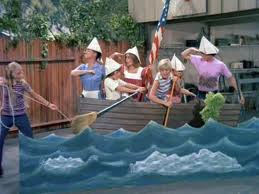
For a Brady fan, any episode can produce a warm and fuzzy glow of nostalgia. But most of the shows that are still pretty funny are the ones featuring Peter: there's “The Personality Kid,” with the pork chops and applesauce bit, and “The Private Ear,” where Pete bugs his siblings’ rooms. To that list I’ll add “Everyone Can’t Be George Washington,” in which Peter auditions to play the Father of Our Country in a school play, and is cast instead as Benedict Arnold. The best moments are at the dress rehearsal, especially when Benedict’s wife Peggy, played by Florence Henderson’s daughter, Barbara Bernstein, pulls out Arnold’s old army uniform. 


Father Knows Best
“24 Hours in Tyrantland”
Now this - this is a remarkable piece of history, shot in 1959 but never aired on television – nor was it intended to. It was commissioned by the US Treasury Department as a warning against the dangers of totalitarianism, and played for years in schools and churches across America.

The story has Jim Anderson – the ever-stalwart Robert Young – trying to get his family to join him in a campaign to sell US Savings Bonds. The kids basically blow him off, saying that bonds might be a good investment but all that patriotic stuff is rah-rah nonsense. Jim, desperate to teach them that bonds preserve the American way of life, proposes a challenge – to see if they can survive 24 hours under a dictatorship – with good old dad as the dictator.

The kids go along and Jim gives them the full treatment; hard labor, unfair working conditions, and severe punishment for trying to escape. “If our young people don’t think enough of our way of life to try to preserve it,” he tells his wife Margaret, “I shudder to think what’s going to happen to America.”

Whether you embrace the message as powerful and patriotic, or dismiss it as the kind of anti-Communist propaganda that produced McCarthyism, “24 Hours in Tyrantland” offers a fascinating insight into life in 1950s middle America.