Showing posts with label Father Knows Best. Show all posts

Wednesday, December 14, 2022

The Prose and Poetry of Father Knows Best


In the film National Treasure, Nicolas Cage plays historian Benjamin Franklin Gates, who reads with admiration a quote from the Declaration of Independence, just before he steals it to keep it out of enemy hands:


“But when a long train of abuses and usurpations, pursuing invariably the same Object evinces a design to reduce them under absolute Despotism, it is their right, it is their duty, to throw off such Government, and to provide new Guards for their future security.”


“People don’t talk that way anymore,” he says, and you hear in his voice a longing for a time when that was not the case.


That is often my reaction after watching an episode of Father Knows Best. Out of all the 1950s situation comedies, this is the series that most often celebrated the eloquence of language, not only by quoting its masters from decades and centuries past, but also through the stirring and articulate scripts from writers like Roswell Rogers and Paul West. 
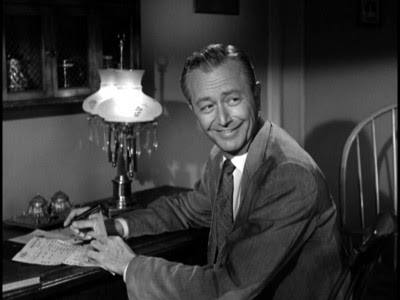


Take this scene from “The Great Guy,” an episode in which Bud and his friend Kippy get jobs in the circulation department of their local newspaper. On their first day the boss, played by the fine character actor Whit Bissell, explains why working on a newspaper is a sacred trust.


“A newspaper is the mirror of man. It’s his conscience, and his crusader. It dries his tears for him, and laughs up his jokes. It shouts his triumphs and records his failures. It brings him into the world and buries him. And finally it goes to its own death carrying out his garbage. But more important than that, it’s the living moment. It’s not yesterday or this morning, it’s now. A late newspaper is no newspaper at all. You can run off five million copies, but that paper does not exist until it’s in the hands of a reader.”
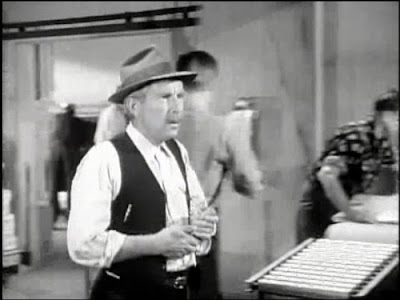


I sat through a lot of journalism classes in high school and college, and never heard a better description than that one.


Perhaps the best-remembered example of oratory from this series is the prayer Jim recites at the end of the first season episode “Thanksgiving.”


“Oh Lord, we give thee thanks from the depths of our humble hearts for all the blessings thou has seen fit to bestow upon us. We thank thee for the food, which graces our table, the roof, which covers our head. We thank thee for the privilege of living as free men in a country which respects our freedom and our personal rights to worship and think and speak as we choose. We thank thee for making us a family, for giving us sincerity and understanding. But most of all, dear Lord, we thank thee for giving us the greatest gift a family may know--the gift of love for one another. Amen.”
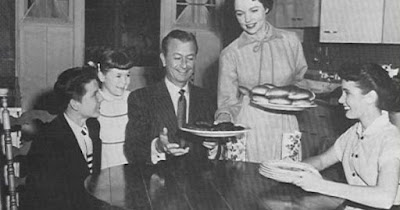


The plot of that holiday episode revolves around Jim’s pride after leaning that Kathy wrote the best Thanksgiving poem in her class. Upon hearing the news, he expresses his own love of poetry by reciting Shakespeare’s Sonnet 18:


Shall I compare thee to a summer’s day?
Thou art more lovely and more temperate.
Rough winds do shake the darling buds of May,
And summer’s lease hath all too short a date.


And in the midst of his recitation, his secretary enters the office and picks up the next verse without missing a beat. It’s nice to think about a world where everyone can quote Shakespeare from memory.


In “Homing Pigeons” the family marvels at how Bud’s pigeons are able to find their way back to their cages from hundreds of miles away. 
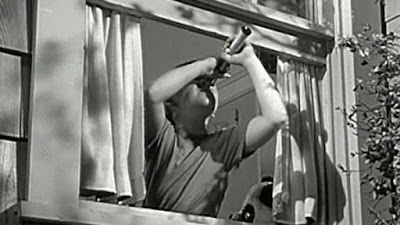


“How do they do it?” Margaret  asks. In response Jim pulls out a poetry anthology from the living room bookshelf. “There’s a poem by William Cullen Bryant about another bird that might give us the answer”:


There is a Power whose care

Teaches thy way along that pathless coast –

Long wandering but not lost.

All day thy wings have fanned

at that far height, the cold thin atmosphere,

Yet stoop not, weary, to the welcome land,

Though the dark night is near.


He who, from zone to zone,

Guides through the boundless sky thy certain flight,

In the long way that I must tread alone,

Will lead my steps aright.


In “The Old Days,” Jim is looking through costumes for a party, when the shopkeeper recommends he and Margaret dress as Robert Burns and Elizabeth Barrett Browning. That inspires the men to quote from Burns’ most famous poem:


The year’s at the spring,

And day’s at the morn;

Morning’s at seven;

The hillside’s dew-pearl’d;

The lark’s on the wing;

The snail’s on the thorn;

God’s in His heaven,

All’s right with the world!


And in “Betty Goes Steady,” a boy Betty disdains because of peer pressure (played by Robert Vaughn!) gives her a book of essays by Ralph Waldo Emerson, and suggests she reads the one called “Self-Reliance.” 


“There is a time in every man's education when he arrives at the conviction that envy is ignorance; that imitation is suicide.”


We hear these words through the characters but it’s the writers who insert them into the scripts. Why did they do it? Perhaps because as writers they have a greater appreciation for words – and for those who use them well. And perhaps they hoped that a reference to a poem or an author in the midst of a 30-minute comedy would inspire a viewer to reach for a long-untouched book on a dusty shelf, or go to the library the next day if no such volume was handy.


That was one way knowledge and culture could be passed down, especially to younger people who might be more receptive when a lesson emerged from television instead of the classroom.


But people don’t talk that way anymore. Even on television. Especially on television. I wish they still did.

Wednesday, February 2, 2022

One Night, Two Dates: The Classic TV Teen Dilemma


When I was in high school, having two dates scheduled for the same night was the kind of dilemma with which I never had to contend. Just trying to get one date was challenge enough. But the kids on Comfort TV shows were better looking and more popular, so it’s not surprising that this situation occurs in more than one classic show. 


How do they get themselves into these messes, and how did they handle it? Let’s find out. For each show, our double-date protagonist has been given a rating of 1-10 on the two-timer scale: a one means they’re relatively blameless; a 10 means they definitely need a stern talking-to from mom and dad.


“The Rivals”

Father Knows Best

Poor Betty Anderson has fallen into a rut in her relationship with reliable old Ralph. Her flirty friend Marge (played by Barbara Eden!) is always flitting between a half dozen steady boyfriends and telling Betty how lucky she is that no other boys are interested in her. 


She probably meant that as a compliment.


But when they’re doubling at a diner one Saturday night Betty runs into Doyle Hobbs, who she met last summer while briefly working as an engineer on a survey crew (in an episode aired the previous season - a rare bit on continuity for this series). 


So to prove to Marge she can land another guy she accepts a date to a concert in the park – even though she already agreed to go with Ralph.


What makes “The Rivals” such a fun episode is how Betty’s parents react to her dilemma. Jim is disappointed that his daughter would be so devious, while Margaret thinks every girl should occasionally get to enjoy that kind of adoring attention. But while Betty decides how to resolve the situation, Doyle stops for gas where Ralph works and they get to talking about Saturday. The final scene is as unexpected as it is delightful.


Lots of star power in this episode: In addition to Barbara Eden, Doyle is played by Roger Smith, later of 77 Sunset Strip.


Two-Timer Ranking: 8


The impulse to impress Marge is understandable, but not resolving the situation, even on the day of the date, cannot be excused.


“Mary’s Double Date”

The Donna Reed Show

The day before the Junior Prom, Mary Stone has a decision to make: “Whether to let Phil take me or Ernie.” She plays them off each other like a symphony conductor, while simultaneously avoiding a third suitor, Charlie, whom she affectionately describes as her “door mat.”


She gets asked by both her choices, as expected, and doesn’t plan to let the loser know until 5pm on the day of the dance. But her comeuppance arrives before then, swift and severe and well deserved. “You played a dangerous game, and you lost,” Donna tells her, gently, “so no tears.” 


Two-Timer Ranking: 9


This episode is pure magic. Wonderfully written and endlessly quotable: “It’s wonderful to be attractive and popular, but you have to learn to use that power gently, and with kindness.” Its been nearly 40 years since I was in high school, and I still recall the names and faces of a couple of queen bees who failed to heed that advice. And some of those moments still sting.


“The Subject Was Noses”

The Brady Bunch

Marcia gets starry-eyed when big man on campus Doug Simpson asks for a date on Saturday night – then remembers she already has a date for Saturday with “plain, sweet, ordinary” Charlie. 


Predictably, like Molly Ringwald in Pretty in Pink she decides to stick with the handsome popular boy over his undersized rival. But unlike Betty Anderson and Mary Stone she at least has the good sense to not let the situation linger until the weekend. Greg offers sage advice – break the date with Charlie by using the lame but surprisingly effective excuse of “Something suddenly came up.” And it works, until karma arrives in the shape of a football that hits her in the face.


“The Subject Was Noses” certainly ranks as one of the most memorable series episodes, especially in how the tables are turned against Marcia when her same date-breaking excuse is used against her.


Two-Timer Ranking: 4


Marcia not only lets Charlie down easy, she apologizes for her deception and learns her lesson.


“Double Trouble”

The Partridge Family

Keith tries to get a date with gorgeous Joanna Hauser, aka “Miss Everything,” but she’s already going to the big beach party with her steady, who goes by the name “Spider.” Laurie offers to set him up with bookish Sally Winkler from the Shakespeare club. Keith reluctantly agrees, and then Spider’s plans change so Joanna is available again. Now he has two dates, but only wants one of them. “So what’s the problem?” Reuben asks. “Dump the nice one and go with the knockout!” No wonder he’s still single.


Instead, Keith fakes a cold to let Sally down easy – but fate has other plans.


Two-Timer Ranking: 2


Technically, Joanna became available before Laurie told Sally about the party, so he never should have been stuck with two dates in the first place. And while pretending to be sick is a pretty gutless solution, Joanna Hauser is played by Cheryl Ladd, so desperate measures in this case are more admissible. 


“Who’s Crazy Here?”

Eight is Enough


Tommy likes both Gretchen and Sherry, so he dates them both at the same time. “Don’t say I didn’t warn you,” cautions older brother David.


This is the B-story of the episode, so it doesn’t get as much screen time as Tom’s bout with insomnia and the misunderstandings it triggers.


Two-Timer Ranking: 6


Tommy avoids direct conflict by scheduling one date for 8pm and the other for 10pm, so here we have a case of breaking the spirit of the law more than the letter. But to expect two girls that attend the same high school to never figure out what’s happening explains why Tommy was never considered Honor Society material.


“Double Date”

Family Ties


Like Keith Partridge, Alex Keaton is turned down when he asks his dream girl to the senior prom, and then asks another girl instead. But then the first girl becomes available, and he decides to keep both dates. He devises a plan with the help of his friend Skippy:


Alex: “Okay, let's go over the plan once more. Now, the north end of the gym is now called...”


Skippy:  “Area "A".”


Alex: “Okay. At no point is Rachel to enter area "A" - prior to 8:57. Now - areas "B" and "D" are free zones which means... Either girl may enter provided the band is not on a break at the time. Now remember, when I'm with Rachel, I'm gonna be wearing the blue boutonniere. When I'm with Jocelyn - the red one. There are emergency exits at either end of the gymnasium. The master switch box is behind the blue wrestling mat. This will allow you to switch off the lights, lower the backboards, and in case of an emergency, open the floor over the swimming pool. Let's hope it doesn't come to that. 


Two-Timer Ranking: 10


“We’re going to make history,” Alex tells Skippy, but of course his arrogance proves his undoing. The dates in question were played by Jami Gertz and Daphne Zuniga, making this episode about as classic 1980s as you can get.


Friday, February 26, 2021

The Subversive Pleasure of Watching Christmas Shows After Christmas


March is right around the corner, but this week I watched two classic Christmas episodes: “The Angel’s Sweater” (Father Knows Best) and “The Voice of Christmas” (The Brady Bunch). 


Why? Because I can remember a time when doing so wasn’t possible. 


I think you would have to be over the age of 50 to understand the satisfaction that comes with watching a Christmas show out of season.


Until the first videocassette recorders hit the consumer market, watching any episode of television – especially a Christmas episode – was often a one and done experience. Holiday shows were rarely rerun over the summer, and usually left out of the line-up when that show went into syndication.


That’s why, even after decades of watching The Brady Bunch in reruns, I did not see “The Voice of Christmas” until sometime after the year 2000. That’s more than a decade after A Very Brady Christmas aired in 1988.


When I watched it the other day, I remembered as I always do what it felt like to finally see it during a holiday marathon on TV Land, and what a treat it was to experience a “new” episode of this show so many years after it ended. 


I enjoyed every moment: Carol’s excitement over singing a solo in church jeopardized by a sudden case of laryngitis; the Brady boys trying to shove a huge Christmas tree through the front door, until their dad shows them an easier way; Mike, confident that he lived in a healthy, functioning society, leaving his six year-old daughter alone in a department store while she waits to meet Santa; that greedy little brat in line next to her, with his pretentious ascot and his mile-long want list. Cindy’s shining blue eyes after Santa promises her mommy will get her voice back in time: “He’s better than a doctor. He’s Santa Claus.”


From the opening scene of Alice wrapping presents to Florence Henderson’s rendition of “O Come, All Ye Faithful,” it’s everything I could have wanted from a holiday episode of a Comfort TV classic.


“The Angel’s Sweater” is another standout Christmas episode, which I saw for the first time when the third season of Father Knows Best was released on DVD. It features a lovely and even profound fairy tale within the story (written by Roswell Rogers) that begins in the Anderson home with the pending arrival of Jim’s sister Neva. 


It’s apparent from the reactions of his family that this is one of those annual holiday relative visits that happens more out of obligation than preference: Neva is a dour woman who no sooner arrives than she starts complaining about “kids running around” during her travels. Kathy bears the brunt of Neva’s barely-suppressed anxiety around children. After the inevitable blow-up between them, Jim has no time to moderate a truce because of a burst water pipe.


Finding a repairman to make a house call on Christmas Eve? Seems unlikely – but not in Springfield. Enter Mr. Fix-it – a jolly old man with an accent from the old country who fixes the pipe, while telling Kathy a story about Katrina, a little girl just like her. 


The tradition among residents in Katrina’s small fishing village is to buy the nicest Christmas gift they could find and give it to the church as an offering for the poor. Katrina agonizes over what should she give, “What is the greatest gift?” she wonders. An angel tells her it’s a secret that everyone learns in a different way. And when Katrina learns that lesson, Kathy does as well.


It’s a beautiful story, no less resonant in March than it is in the weeks leading up to Christmas.


So many of the trappings of the season can only be enjoyed in November and December: the egg nog that suddenly appears in your grocer’s freezer between the milk and the cream, the carols added to radio station playlists; but it’s nice to live in a time when these Christmas classics are accessible whenever I need a holiday spirit booster. I’m already looking forward to July, when it will be 110 degrees in Las Vegas, and I’ll be watching Bob Hartley get stranded in a Chicago blizzard.

Wednesday, September 26, 2018

Just a Really Good Episode: “Bud The Philanthropist”


In a previous blog I wrote, “There’s something remarkable about Father Knows Best. You can watch any dozen episodes and be entertained by the wholesome charms with which this 1950s sitcom is identified. And then you’ll discover a story that is so compelling in its content that you could write a term paper about it.” 


That piece singled out some of the series’ most memorable episodes, and one of these days I’m going to do an “Unshakeables” piece on “Twenty-Four Hours in Tyrantland.” It is one of the most unique moments of television in the medium’s history.


But the other night I watched “Bud the Philanthropist,” a comparatively typical series offering, and was struck once again by how smart and perceptive and entertaining an “average” episode of this 60 year-old series can be.

When you think about TV shows from that time, and how different life in America is now compared to back then, it may seem unlikely that today’s teenagers could see themselves in their 1950s counterparts. But the situation Bud finds himself in here, and the range of emotions it generates, would be as familiar now as it was in 1954. “Bud the Philanthropist” won’t stay with you for days like “Tyrantland” or “The Bus to Nowhere,” but I found it remarkable nonetheless because of the universal truths it contains.

The episode opens with Bud and his father waxing the family car – or more like Jim waxing and Bud daydreaming. This is not an uncommon scenario on the series as Bud was a quintessential slacker. Five minutes with him in any episode will dispel any latter-day stereotypes on how 1950s sitcom kids were all perfect.


In this case, however, there is more to Bud’s distraction than laziness. He recounts for his dad events from Sunday school class earlier that morning, where the teacher launched a “good deed” project to help a young newspaper boy, who suffered a broken leg in a hit-and-run car accident. The idea is to raise money to buy him a radio, to help him pass the time while he’s laid up in bed.

A box is placed at the front of the classroom to collect the donations. “No one has to contribute,” the teacher says. “You only do this because you feel in your heart you want to.”

Bud has a $10 bill in his pocket that he had been saving to buy new track shoes. Ten dollars in 1954 is about $100 now, so we’re not talking spare change. He has nothing smaller he can give so he walks out, feeling the stares of his classmates behind him. But a few moments later, after the room has cleared out, he returns and, reluctantly, donates the $10.


Jim expresses his pride at such generosity. “Yeah, but nobody saw me!” Bud protests. “Nobody knows I put in anything!” He wants some recognition for giving all that money to a kid he doesn’t even know.

And as the conversation continues, we hear some of the writing (by the brilliant Roswell Rogers) that makes this series so wonderful.

Bud: “Is that so wrong? To want people to say you’re a nice guy?”

Jim: “No, of course not. But if you put in that money merely to get credit, that is wrong.”

Bud: “Yeah, but…even if I do get credit, the money still does the same good deed, doesn’t it?”

Jim: Well, yes, materially…but with that attitude it’s no longer a good deed on your part. It’s a bargain you’re making. You’re using your money to get a good name for yourself.”

Bud gets the point, but still feels a little cheated. “I wish they knew so they’d know I’m the kind of guy who didn’t want them to know.”

Jim laughs. “You want too much for your money. The real reward is something you feel inside of you.” As they go into the house for lunch, he tells his son, “The two most important ones in the world know: you, and (glancing toward heaven) the one who made up all these rules.”

At lunch, Betty mentions sitting next to the Sunday school teacher in choir, and learns about the good deed project. The teacher was delighted, she says, because the donations amounted to…$10.39. The reactions of Bud and Jim are priceless as they realize the other eight boys in the class couldn’t come up with 40 cents between them.

Now Bud is really steamed, but he keeps his contribution anonymous. The following week, the teacher announces that the money has been raised to buy the radio, and that he could tell by “the arrangement of the contributions” that “most of the credit for this project belongs to one of our members. I’m especially proud of this boy. I don’t know who it is, and I’m sure he doesn’t want it known…but his blessings, his reward, is what he feels inside.”

The rest of the class immediately jumps to the conclusion that it was another boy who gave the $10, and he in turn is given the honor of representing the school at a youth conference, and delivering the radio to its recipient. Once again, Bud protests the injustice of it all to his dad: “What do you think we ought to do about it?”


Jim’s response: “Nothing." He reminds his son once again that the good deed itself is all that matters. 

What happens next? I shouldn’t tell you everything, though I’m constantly amazed at how much story can fit into a 25-minute script on a series as well-written as this one.

“Bud the Philanthropist” is a perfect little morality play, of the kind that was prevalent in prime time in a bygone age. Situation comedies don’t seem to care very much about life lessons anymore. And when you see how boorish behavior in our culture is often applauded instead of condemned, it’s easy to see why such stories have fallen out of favor. And why some of us prefer the old shows to the new ones.

A classic TV moment? Not really. Just one of 204 episodes of Father Knows Best, each having something to say about the human condition – what makes us noble, what makes us flawed, and what sometimes makes us inexplicable, even to our fellow humans. But the message, always, is one that reinforces the actuality of objective moral values and why, if we’re all going to get along, it’s important to pay attention to them.

That, to me, has always been the most appealing aspect of Comfort TV. 


Monday, April 10, 2017

Comfort TV Classroom Crushes


One of the most popular family sitcom stories of the Comfort TV era is the student who develops a crush on a teacher.

I wonder, in the wake of so many news stories about inappropriate teacher-student relationships, if this trope is still popular today. Perhaps, like episodes in which characters get drunk in a funny way, it has been relegated to the scrapheap of ideas that can no longer be explored without offending someone.

That would be unfortunate. For decades the teacher crush was a go-to plot because it could naturally accommodate both comedy and earnest, sometimes painful emotion, which most viewers can appreciate having gone through a similar experience.

For me it was Miss Bobbin in second grade, a hippie chick with long dark hair that wore flowery sundresses and taught barefoot. Ah, the ‘70s.

Looking back on a selection of these episodes, there is an almost even divide between boys falling for female teachers, and girls falling for male instructors.
Most happen in high school, which is understandable. And when the series is set in high school at least one story like this is inescapable. Even the nerdy, reedy-voiced Wally Cox, who played a science teacher in Mister Peepers, became the object of a student’s affections in “The Teenage Crush” (1952). 


No series went there faster than The Patty Duke Show. “The French Teacher” was the first episode of the first season, and has Patty failing French (“a moth-eaten drag”) until her teacher leaves to get married and is replaced by dashing substitute Andre Malon (Jean-Pierre Aumont).


Starry-eyed looks turn to genuine hope after Andre offers to show her Paris if she ever visits. But when Patty starts to make plans for their future, Andre turns to her father for help:

Andre: “I think she wants to marry me!”
Martin: “It would serve you right.”

Patty was among the luckier students in these stories – a solution was found that spared her any feelings of rejection. Bud Anderson of Father Knows Best was not as fortunate during his infatuation with a French teacher in “Bud Branches Out.” Now a college freshman at the start of the show’s sixth and final season, he gets herded into French by mistake and decides to stick around after an amour-at-first-sight glance at Miss Luvois. 


Through one of those patented sitcom misunderstandings, a dinner invitation to Bud sent by his girlfriend is delivered by Miss Luvois, and he thinks it’s from her. Standing outside her home with flowers in hand, he learns the hard way that it wasn’t. But don’t feel too bad for Bud, as the girlfriend he returns to is played by gorgeous Roberta Shore.

Heartbreak usually passes quickly in these situations. In The Brady Bunch episode “The Undergraduate” the family can’t figure out why Greg is flunking math. Alice finds a note in his pocket addressed to “My true love Linda,” but after paging through a yearbook they can’t find a Linda in his class. The mystery is solved when Mike opens a school conference invitation from Greg’s math teacher – Linda O’Hara. 


Greg remains smitten until he meets Linda’s fiancé, Dodger first-baseman Wes Parker (playing himself). He offers Greg tickets to the season opener if the kid gets his math grade up, and Greg happily chooses baseball over love.

Such bribery would not work with Cissy Davis on Family Affair; her crush vanished when she learns the object of her affection is a jerk.

In “Think Deep” Robert Reed plays philosophy teacher Julian Hill, the kind of supercilious twit still found in higher education. But he has a goatee and says things like “The true personality is hidden beneath a welter of self-denigration,” and that was enough for Cissy. But then Uncle Bill invites him to dinner and the twins spill coffee on his suit, prompting the outraged Julian to call them “little monsters.” The shattered look on Cissy’s face says it all. 


The show seemed to take another run at this plotline two seasons later in “The Substitute Teacher,” in which Jody develops a fascination with Miss Evans, wonderfully played by June Lockhart. Turns out this time it’s not puppy love, but Jody gravitating toward her because of her resemblance to his late mother. Few shows delivered that kind of emotional gut-punch better than Family Affair. 


While most crush stories are told from the student perspective, Room 222 explored how the situation can be just as distressing to the teacher. In “The Coat” guidance counselor Liz McIntyre (wonderful Denise Nicholas) helps a troubled student get a job at a department store, and he mistakes her professional interest for something more. He buys her an expensive coat from the store to show his affection (actually he steals it, but it’s the thought that counts). Liz agonizes over the proper response, knowing that the wrong one may drive a dropout risk out of school for good.

Then there are those rare episodes where the student’s attraction is actually reciprocated. On The Facts of Life, the two-part episode “Taking a Chance on Love” has 19 year-old Jo embarking on a romance with her 30 year-old photography teacher. And on Wings, Brian gets to live the dream by spending the night with his ninth-grade English teacher (played by Peggy Lipton!) in “Miss Jenkins.” 


Unfortunately, he gets so caught up in the fantasy he can’t handle reality.

Joe: “You mean…”
Brian: “I got an incomplete.’

Do I have a favorite? Glad you asked. The episode is titled “I Love You, I Love You, I Love You, I Think” and it’s from Gidget. It starts when Gidget meets an older guy on the beach and they start surfing together. 


She loves it when he calls her “a pint-sized adorable doll,” though he won’t admit they have a relationship. “At least for the next five to six years,” he tells her. “Talk to me then and I might make you a serious proposition.”

With school starting next Monday, the mystery man urges Gidget to forget him, and she calls it the perfect romance – “over before it had a chance to begin.” But on Monday she walks into math class and guess who’s her teacher?

This was the pivotal scene, because given the flirting and feelings and the now much more obvious age difference, it could easily play the wrong way. But while the moment is every bit as awkward as it should be, it’s also hilarious, because of some unexpected slapstick moments and because Sally Field is a gifted actress.

Teacher and student finally talk things out, but a lot of stuff implied on the beach is deftly sidestepped in the climax, probably because there was no better way out. Still, this is one of those TV episodes that's a lot more complex and provocative than its creators intended.


If you’d like to plan your own teacher crush classic TV night, you have many other options to choose from:

“Beaver’s Crush” (Leave it to Beaver)


“Another Day Another Scholar” (The Jimmy Stewart Show)
“The Love God” (My Three Sons)
“Love at First Byte” (Head of the Class)
“The Communication Gap” (Nanny and the Professor)

Each one offers its own variations on a story that almost always makes for fun television.

Tuesday, October 18, 2016

Foreign Relations in 1950s Television


During this contentious election year there is much being said about how people who are different are getting along. The short answer, it appears, is not that well.

This isn’t the forum to talk about the ebb and flow of tolerance, and how some situations were clearly worse 50 years ago, while many others seemed so much better than they are now.

Instead, let’s see what happens when vintage TV shows approached this topic.

I always like these episodes. They reveal how much bigger the world seemed in the pre-Internet era. For the heartland residents of golden-age sitcoms, the chance to meet someone born outside the U.S. didn’t come along every day. That perspective influenced how outsiders were portrayed, as well as how they were received by the characters viewers watched every week.

Often these shows fell back on cultural stereotypes that could be viewed as naïve now, or offensive if you’re the sort that likes to be offended about everything.

But that was not how they were intended. If anything, writers viewed these scripts as opportunities to educate viewers about the ways different populaces lived and dressed and spoke, while also offering an outsider’s perspective on American life and culture. That required an emphasis on divergence, though inevitably an underlying message would emerge on how people are people, no matter where they are from.

Here are three intriguing examples.

“Fair Exchange” (1958)
Father Knows Best
The Andersons play host to Chanthini, an Indian exchange student played by Puerto Rico’s own Rita Moreno. 


“Will she have a shawl on her head and a water bucket on her shoulder?” Kathy wonders, while Bud hopes she knows the Indian rope trick. Chanthini is also not immune to jumping to conclusions: when she sees an apron-clad Jim helping with the dishes she assumes he’s a servant. In her country, she says, the men don’t do kitchen work. “You people have the right idea,” Jim responds.

“Fair Exchange” offers a textbook example of how this story trope often plays out. “Did you know?” lessons are frequently inserted (not always gently) into the script: “What’s that little red dot on your forehead?” Kathy asks Chanthini; “We get most of our tea from India,” Margaret informs her family.  And as we’re still in the 1950s, everyone admirably tries not to offend each other. The final scene, where Bud tries to teach Chanthini about football, is one of those utterly charming moments that TV has long since forgotten how to create.

“The Duenna” (1957)
The Adventures of Ozzie & Harriet
David meets Lucita, an attractive girl who speaks only Spanish. Somehow they manage to make a date, but he is confused when she calls later and he can’t understand her. 


A half-hearted attempt to translate reveals one word familiar to Ozzie – “duenna,” meaning chaperone. Apparently it’s Spanish tradition for girls on dates to be accompanied by a grandmother or maiden aunt. Ozzie tags along to accompany the chaperone, but is taken aback when the duenna turns out to be an attractive senorita with amorous intentions. 


The episode plays without subtitles, except for one brief scene needed to clarify the plot. Thus, viewers are as challenged by the language barrier as David, which heightens our awareness of how difficult these situations can be. What is engaging is the good faith effort made on both sides, without any expressions of impatience or frustration.  

“The Geisha Girl” (1961)
The Donna Reed Show
The wife of the new doctor in town gains a reputation as a snob because she never attends social events. Donna believes such pre-judgments are unfair and drops by for a visit. She discovers that the woman in question is not only Japanese, but also someone who prefers the traditional garb and subservient role of a wife common to her homeland. 


Later, at a small dinner party, the other doctors’ wives stare in disbelief as she serves her husband dinner and lights his pipe. The doctors find her deference admirable. “Don’t let it give you any ideas,” Donna cautions her husband.

Here we do see a suggestion of prejudice, though it is quickly proven false. But there is a discomfort among the ladies of Hilldale with someone who acts so submissive, and that in itself is interesting given how many women today might view the traditional homemaker roles that are esteemed in TV shows of this era. 

The final scene shows what happens when Donna takes it upon herself to Americanize the woman. One shopping trip later our visitor from Japan has joined the ranks of Hilldale’s stylish Midwestern homemakers.

But how will her husband react to his new wife? As it turns out, he’s delighted to see her making friends and embracing her new life in a new country. Assimilation is portrayed as a triumph for the immigrant and the community. If only that were still the case. 

Monday, November 16, 2015

Paris, Thanksgiving and Father Knows Best


So I was all set to write another Museum of Comfort TV piece and then Paris happened. Of course, this isn’t the forum to discuss such atrocities, but the impact was such that it didn’t feel right to proceed with my original topic.  

Instead, let’s talk about Thanksgiving, and Father Knows Best. Seems more fitting, I think, since the holiday was inspired by a moment when disparate groups of people came together in peace and friendship. It didn’t last, but it gave us a glimpse of what we can be at our best. We need more of those now.

Several classic TV shows had Thanksgiving episodes, though even 40 years ago the holiday was overshadowed by the more vibrant sacred and family traditions of Christmas and the material-rich spooky fun of Halloween. Both evoke myriad ideas that would work for almost any kind of series.

Thanksgiving is more of a challenge. It’s always tough and time-consuming to shoot a large group of characters seated around a dinner table, and such scenes feature very little movement outside of passing the sweet potatoes and the biscuits.

Unless you unleash a food fight.


There were football games and parades on Thanksgiving in the Comfort TV era, but would you want to watch a television show in which the characters are also watching TV? Not very exciting.

Friends had some great Thanksgiving shows but it’s a bit out of our era, though I did cover the series once before. And Bewitched offered a delightful holiday episode in its fourth season (“Samantha’s Thanksgiving to Remember”) in which Aunt Clara accidentally blinks Sam, Darrin, Tabitha and Mrs. Kravitz (!) to the Pilgrims’ Plymouth settlement. I watch it every year around this time. 


But my topic for today is “Thanksgiving Day,” from Father Knows Best. It was just the eighth show of the series’ first season, so at the time America was still getting to know the Andersons of Springfield (a radio version had aired for five years already, but that series had a much different tone).

In the story, the Andersons decide that Margaret deserves a break from cooking, and instead they’ll all go out to a restaurant for Thanksgiving dinner. But then Bud announces he’s going to spend the day with his high school football team, and Betty accepts an invitation to dine with a neighbor’s family. “She didn’t think you’d mind,” Margaret tells Jim, “as long as we were eating out.” “No, of course not,” Jim mutters, though it inspires reflections of the Thanksgiving traditions he cherished as a boy, and how times have changed.  


There’s another plot about Kathy having an emotional meltdown, but these were fairly common occurrences in the Anderson home. So let’s skip past that to Jim having second thoughts about dining out. “I’d just rather eat here,” he tells Margaret, even though all they have in the house is hamburger.

Perhaps, even if you have never watched this episode, you can guess what happens next. Kathy calms down, and Bud and Betty heed an innate call to home and hearth and realize that is where they should be and want to be on this special day.

The episode ends with the family seated around the kitchen table, on which sits a platter stacked with hamburgers. The Andersons join hands, as Jim offers a prayer of gratitude for the blessings they have received. One particular part of that recitation brings us back to Paris and the challenges of the times with live in now:

“We thank thee for the privilege of living as free men in a country which respects our freedom, and our personal rights to worship and think and speak as we choose.”

There are people in this world who want to take that away from us. And not all of them are terrorists. It’s something to think about as we keep Paris in our thoughts and prayers, and look forward to our own family Thanksgivings.