Showing posts with label Get Smart. Show all posts

Wednesday, January 22, 2025

My 50 Favorite Classic TV Characters: Don Adams as Maxwell Smart

Let's first acknowledge the obvious reasons why Get Smart remains one of the crown jewels of television comedy.


Start with the clever foundation laid by genius creators Mel Brooks and Buck Henry; the perfect casting of Don Adams as Maxwell Smart, with equally memorable support from sultry Barbara Feldon as Agent 99 and Edward Platt as Max’s exasperated Chief; the movie spoofs (“Bronzefinger,” “Witness for the Persecution”); the catchphrases (“Missed it by that much”); surefire visual gags like the Cone of Silence; guest characters that would be delightfully offensive to easily-triggered modern sensibilities (The Claw, Harry Hoo).


And many, many more. But there’s one ingredient in this remarkable mix that is not always acknowledged: the show was perceptive enough to not make Max stupid all the time. 

Even if part of the intent was to spoof both James Bond and U.S. covert agencies that had come under increased scrutiny in the late ‘60s, making Max a complete moron would have quickly become tiresome. He would often be clueless and clumsy, but usually he would also complete his missions, knock out a few bad guys, and keep the world safe from the evil plots of KAOS.

Contrast this with, say, Gilligan on Gilligan’s Island. In every episode, a rescue plan is foiled because Gilligan screws up. The only suspense is in exactly how he’s going to doom his fellow castaways to another week on the island. There was no point is rooting for him to be a hero. Max, despite his mistakes, could still save the day, much to the amazement of everyone around him. 


The stars seemed to align to bring this series to magnificent fruition, though there were some bumps along the way. The pilot was first offered to ABC with Tom Poston cast as Max. When ABC turned it down, NBC picked it up – not because they had a lot of confidence in the idea, but because they already had comedian Don Adams under contract and wanted to get something out of that investment. 

They didn’t know how fortuitous that decision would prove. With Adams in place, Maxwell Smart was not a character that had to be developed or shaped by the first scripts. He was fully formed before the first scene of Get Smart was shot. If you watch Adams as hotel detective Byron Glick on The Bill Dana Show, you’re seeing the birth of Max – same mannerisms, same line delivery – he was even using the “Would you believe” routine that became one of Get Smart’s best recurring bits.

Another reason I believe this is one of the most perfect matches of actor to role of the Comfort TV era, is how, in a different world, Don Adams could play it straight and make an audience accept him as a dashing secret agent - at least when he wasn't talking into his shoe. 


That debonair quality would be on display early in several scenes, as he’d walk confidently into a potentially fatal encounter, gun drawn…and then fall down the stairs. 

As gifted a physical comedian as Adams was, it’s his voice that is first recalled as a defining characteristic. The network asked him to tone it down a bit after the pilot, but thankfully it wasn’t dialed back far enough to lose that nasally quality inspired by William Powell in the Thin Man movies. Adams was also a gifted mimic, working in credible impressions of Humphrey Bogart and Ronald Colman in some of the series’ most fondly remembered episodes. 

Fifty years later Get Smart remains one of the most laugh-out-loud comedies ever created. In 1965, when one of the Gemini 7 astronauts suffered a minor technical malfunction in his space suit, the response from Mission Control was “Sorry about that, Chief.” That’s how you know a series has fully penetrated the pop culture.

Even on a tenth viewing of an episode when you know the jokes are coming, they still land. That’s a testament not only to Adams, who won the Emmy three years in a row for his portrayal of Agent 86, but to the entire cast, including occasional regulars like Hymie and Larrabee and Agent 13, not to mention the villainous Siegfried (Bernie Kopell) and William Schallert as the first Chief of CONTROL. 
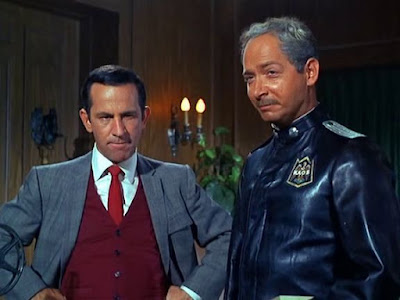


Classic episodes? Where do you even start? The pilot, pitting Max against a villain known as Mr. Big (when you see him you’ll know this show was politically incorrect from day one); “Washington 4, Indians 3,” in which a Native American tribe threatens to take back their stolen land by force with a weapon that, to me, may be the best sight gag in 1960s television; “A Man Called Smart, Part 1,” featuring a masterpiece of slapstick comedy starring Don Adams, a stretcher and a revolving door.  

And about 50 or 60 more. Yes, the series did start to run out of gas in its fifth and final season, with Max and 99 married and becoming parents (did that ever work to save a troubled show?). But by then viewers had already been gifted with more laughter than most sitcoms manage in twice as many seasons. And Don Adams was doomed to a typecasting fate that befell many other creators of iconic television roles. 

Sorry about that, Don. But I wouldn’t trade a minute of this series for anything. 


Monday, November 19, 2018

Classic TV’s Most Unconvincing Indians


November means Thanksgiving, a time to remember that celebrated moment when Pilgrims and Indians shared a festive dinner table. Many of us first learned about the history and culture of Native Americans while studying Thanksgiving in elementary school. Hopefully those lessons were more accurate that what we learned from television during the Comfort TV era. 


I’m not going to condemn or defend the broad portrayals of Native-Americans in situation comedies. But I will say that when they were funny, I laughed. I don’t think that makes me a horrible person, but then we are rarely the best judges of our own characters.

There were a few (comparatively) earnest portrayals in this era as well, beginning with Jay Silverheels as Tonto on the classic Lone Ranger series. 


It helped that Silverheels was indeed Native-American – a Mohawk from Six Nations of the Grand River in Ohsweken, Canada. While he spoke in the broken English common to most Indians in film and TV westerns (“Him dead, kemo sabe”), there was also dignity in the character, and frequent acknowledgment that this “faithful Indian companion” was not a sidekick but a full partner in the Lone Ranger’s crime fighting exploits.

And then there was this guy:


Nearly 50 years later it is still a remarkably effective public service announcement, even if the crying Indian, billed as Iron Eyes Cody, was actually an Italian actor named Espera DeCorti. His work here belies the now common assertion that performers should always be the same ethnicity as the characters they play. Could anyone else have made that final image more heartrending?

I think I’d also have to put Ed Ames in the positive category, for his long-running portrayal of Mingo on Daniel Boone (and perhaps also for the most famous tomahawk throw in the history of television).


But enough praise – let’s get to those offensive but amusing stereotypes. Here are the nominees for classic TV’s most unconvincing Indians.

Bernie Kopell as Black Salmon
Petticoat Junction (1964)
In “The Umquaw Strip,” series villain Homer Bedloe discovers that the Cannonball passes through a stretch of land that was never legally acquired from the Indians. His scheme to shut down the railroad fails, but it does offer a chance to see Bernie Kopell, one of TV’s most prolific sitcom character actors, play a member of the Umquaw tribe (one who attended Harvard Business School).

Don Rickles as Bald Eagle
F Troop (1965)
If any series specialized in the type of Native American ethnic humor that typified this gleefully unenlightened era, it’s F Troop.


As if Frank DeKova’s recurring role as Chief Wild Eagle was not enough, the show featured a succession of guest stars who joined the tribe for some equally inappropriate banter, none more memorable than Don Rickles in “The Return of Bald Eagle.”  Rickles is totally unhinged as Wild Eagle’s soldier-hating son. 


Don Adams as Running Creek
Get Smart (1965)
A rogue band of Indians called the Red Feathers demand the return of their stolen land, or they’ll unleash a powerful new weapon. Max infiltrates the tribe and winds up engaged to the chief’s daughter. Of course Agent 86 in buckskins is funny, but “Washington 4, Redskins 3” also unveils one of the funniest sight gags in the history of television. The first time I saw it, I thought I’d never stop laughing. 


Edward Everett Horton as Chief Screaming Chicken
Batman (1966)
The plot of “An Egg Grows in Gotham” is strikingly similar to the Petticoat Junction episode with Bernie Kopell: Arch-criminal Egghead (Vincent Price) finds a technicality that would revert ownership of Gotham City to the Mohicans, now led by Chief Screaming Chicken. Edward Everett Horton steals every scene he’s in with the sort of lines you couldn’t say now without getting in trouble: “Indian poor businessman, my cousin, he sell Manhattan for 24 dollars, could have got 35!”


Burt Reynolds at John Hawk
Hawk (1966)
We’re told that John Hawk, detective with the New York District Attorney’s office, is a full-blooded Iroquois, but that just seems like something this short-lived series came up with to make a standard character more exotic. It’s also a role entirely unsuited to the charismatic Burt Reynolds. The stoic Hawk rarely cracks a smile and speaks in a slightly clipped monotone – like an urban Tonto. It’s a well-shot series that still has its supporters, judging from the high IMDB episode ratings, but Reynolds wasn’t one of them. It was a frequent target of his self-deprecating Tonight Show appearances. If you’re curious, check out the first episode, which features Gene Hackman as a Bible-quoting psychotic killer. 


Raymond Bailey as “Chief” Drysdale
Beverly Hillbillies (1967)
As in Petticoat Junction, another Paul Henning series, we have a white man impersonating an Indian to make a few bucks. Co-written by Henning, “The Indians are Coming” opens with the Clampetts learning about a minor border issue between their oil-rich land and the adjoining Crowfeet Indian reservation. At the bank, Mr. Drysdale is roused by the news: 

“They hit a gusher there! Send a message to my red brothers – Milburn Drysdale speak with straight tongue…send all black wampum my bank, we put in solid steel teepee.”

Miss Jane: “No…there’s been a boundary dispute and the Indians are claiming part of the Clampett oil land.”

Drysdale: “Why those dirty, thieving savages!”

The tribal representatives, Chief Running Wolf and his son, are cultured 20th century men who arrive at the bank to find Drysdale in full buckskins, spouting every Indian cliché from every western movie. The Chief and his son play along, letting him embarrass himself further. 

Willliam Shatner as Kir-ok
Star Trek (1968)
“The Paradise Syndrome” is not quite as bad as “Spock’s Brain” and “The Way to Eden,” but it dwells in the same rundown neighborhood of questionable third-season episodes. The Enterprise visits a planet populated by a tribe that resembles the Native-Americans from earth’s history. Kirk joins the tribe after his memory is wiped, and is soon being worshipped as the great healer, the only brave worthy of marrying the lovely Indian priestess Miramanee. It’s all a bit silly but William Shatner gives it everything he’s got and then some, as he always did to help sell a substandard script. 


Thursday, December 8, 2016

The Ten Funniest Situation Comedy Episodes By Decade: The 1960s


The 1960s was the last decade in which situation comedies favored idealized versions of American life. There would be send-ups of current events, from the British invasion to the spy craze, but the humor was always more sweet than cynical, mischievous instead of mean. That was probably a relief to many Americans as the turbulent decade progressed away from the staid status quo of the 1950s into an era of war, assassinations and political turmoil.  

These were the funniest sitcom episodes of the decade. As with the 1950s list, a two-show per series limit still applies – which sadly renders ineligible about 30 more episodes of Get Smart.

The Dick Van Dyke Show
“The Curious Thing About Women” (1962)
While this list is not a top-ten ranking, I wanted this episode to be first because for me it was not just another hilarious show in a brilliant series. Watching it first in syndication as a kid, and many times thereafter, my future career aspirations were inspired by the office scene where Rob, Sally and Buddy develop an unremarkable event (Laura opening Rob’s mail before he gets a chance to read it) into a classic comedy sketch. I can’t think of another scripted moment on TV where the abundant joy of creativity that writers occasionally experience was more perfectly expressed. The scenes with Mary Tyler Moore and the inflatable raft were pretty funny too. 


Bewitched
“The Joker is a Card” (1965)
“Yaga-Zoo-Zee, Yaga-Zoo-Zee, Yaga-Zoo-Zee-Zim!”
Paul Lynde makes his first appearance as Samantha’s practical joke-obsessed Uncle Arthur, and it’s one for the ages. Every moment he’s in this is perfect, especially when he offers to teach Darrin a spell to put Endora in her place. The payoff scene is as celebrated a moment as Bewitched ever produced. 


Get Smart
“Mr. Big” (1965)
Everything that made Get Smart one of the funniest series from any decade was already in place in its first episode, written by Mel Brooks and Buck Henry. You got your shoe phone, your Cone of Silence, and a villain sure to incite offense in humorless defenders of political correctness. 


The Lucy Show
“Lucy and Viv Build a Shower” (1963)
While Vivian Vance would remain with The Lucy Show for another two seasons, this episode features the final classic physical comedy sequence that she and Lucy would share. They worked so well together by this time that the shower scene was not even rehearsed before it was filmed. 


Green Acres
“Don’t Call Us, We’ll Call You” (1965)
The first season of Green Acres features one long story arc as Oliver and Lisa Douglas leave New York for Hooterville, so Oliver can pursue his farm livin’ dreams. Every episode brings more surreal frustration; here, having just mastered the generator in the previous episode (“You can’t have a 2 with a 6”), he now finally gets his phone installed – at the top of a telephone pole outside his bedroom window. 


The Andy Griffith Show
“The Big House” (1963)
“Here at the rock we have two basic rules…the first rule is…obey all rules.”
Whether it’s Andy or Opie and Aunt Bee or Floyd or even Otis, whomever you meet in Mayberry will make you feel welcome. But if you’re looking for laughs, the episodes featuring Don Knotts’ as Barney Fife cannot be topped. In “The Big House,” the state police temporarily lodge two hold-up men in Mayberry’s jail, allowing Barney to play hard-boiled lawman. They promptly escape – not once but three times. 


Get Smart
“A Man Called Smart, Part 1” (1967)
Of course you’ll want to watch all three parts of this story, which was originally intended for theatrical release. But it’s the first installment that features a masterpiece of slapstick comedy starring Don Adams, a stretcher and a revolving door. Adams, whose distinct voice and catchphrases were a big part of the show’s success, never utters a word throughout the sequence, and still earns huge laughs. There is also an innovative opening chase scene that portends Adams’ association with Inspector Gadget. 


The Dick Van Dyke Show
“Coast-to-Coast Big Mouth” (1965)
The first episode of the show’s fifth and final season contains the most memorable of Carl Reiner’s always-welcome appearances as Alan Brady. The story has Laura going on a game show and getting tricked into revealing that Brady is bald. Rob’s horrified reaction is hilarious, but the highlight finds Laura trying to save her husband’s job. Her confrontation with Alan, as he sits glowering at his desk behind a display of now-useless hairpieces, remains one of the series’ best moments. 


The Beverly Hillbillies
“The Giant Jackrabbit” (1963)
This is probably the most famous episode out of nine seasons, and while I could make a good argument for a few other classics this is one time where I’m content to follow the crowd. The ‘A’ plot has Granny in full Wile E. Coyote mode, trying to trap a kangaroo she mistakes for a jackrabbit. The ‘B’ plot has the Clampetts trying to order food from a caterer – in the annals of funny one-sided phone conversations, this one is up there with the best of the master, Bob Newhart. 


Hogan’s Heroes
“Will the Real Adolf Please Stand Up?” (1966)
Hogan’s Heroes took the evil sting out of the German army through the bumbling antics of Col. Klink and Sgt. Schultz – but what would happen if the neutered Nazis ever met their fuhrer? Here, Sgt. Carter impersonates Hitler, to distract the commandant while Hogan smuggles secret plans to the underground. Larry Hovis creates the funniest take on one of history’s worst monsters since The Producers. 


Next: The 1970s

Monday, May 2, 2016

The Museum of Comfort TV Salutes: The Cone of Silence


Imagine a place where all of the instantly recognizable objects associated with classic television are on display. It doesn’t exist, so we’ll create it here, and pay tribute to many of our favorite Comfort TV things.

Introduced in the first episode of Get Smart, the Cone of Silence would inspire some of the biggest laughs on what many would argue is still the funniest television series ever created. 


Was this merely an inspired visual gag by series creators Mel Brooks and Buck Henry, or a subtle comment on government incompetence? Imagine how many taxpayer dollars were poured into research and development on something that never did its job. Not the first time, and certainly not the last. Fill in your favorite boondoggle here.

Its presence in the series’ pilot suggests that this was a moment that would help sell the show: Maxwell Smart, dedicated and eager but also clumsy and dense, awaits assignment from the head of the secret government espionage agency CONTROL. The Chief, Max’s boss, hints at how vital this upcoming mission will be. Not willing to take any chances, Max demands his orders be given only within the security of the Cone of Silence. The Chief, exasperated as if he already knows Uncle Sam got stuck with a clunker, calls for it anyway.


That is a perfect classic TV moment.

The scene works so well that it could have been reprised with only minor variations in future episodes and still earned a laugh. But that would have been too easy for a show with this much genius in its origins. The Cone of Silence would make ten more appearances over the show’s five seasons, and the question was never whether it would function as designed, but how it would fail once again.

In “KAOS in CONTROL,” the Cone still impairs communication between Max and The Chief, but those outside can hear every word they say. 

It appears once again in “My Nephew the Spy,” after Max insists that regulations call for all security measures to be taken in such vital circumstances. The Cone is lowered, and the Chief asks Agent 86 what he discovered about KAOS headquarters. Max responds, “Nothing.”

“Too Many Chiefs,” from season one, is my favorite Cone of Silence moment. Here's why:


“Hubert’s Unfinished Symphony” features the debut of the portable Cone of Silence, which looks even more ridiculous than its predecessor. Which is unfortunate for the Chief, who spends most of the episode stuck inside. 


When Max and 99 are on assignment in England in “That Old Gang of Mine,” the London CONTROL office provides its own variation, the Umbrella of Silence. Surprisingly it’s up to the task, but other complications ensue. 


In the season four episode “A Tale of Two Tails” we learn that the Cone was invented by Professor Cohn. “The Cone of Silence was invented by a Professor Cohn?” Max asks, as he looks up at it; “That’s funny…it doesn’t look it.” One more example of a joke that worked 40 years ago and would now generate demands for apologies and sensitivity training.

With the Cone on the fritz again, Max and the Chief opt for the CONTROL secret word file. Once you see how that works you’ll wonder if it was created by the same guy who wrote the federal tax code.

And though it’s not canon I should mention that a high-tech version of the Cone appears in the 2008 Get Smart film with Steve Carrell. Here at the Museum we’re content to own the original, but if you don’t see it on your next visit don’t panic – most likely it just needs yet another tune-up. 


Monday, March 9, 2015

Classic TV Two-Part Episodes: Hits and Misses

 
Theoretically the two-part episode is an option that should be utilized only in conjunction with a major milestone in a series (births, deaths, new character introductions, weddings, big name guest star) or when a writer comes up with an idea that is so good, it deserves a little extra breathing room to be fully explored.

But think back over the hundreds of two-parters presented in the Comfort TV era – how many of them really needed more time to tell their stories?

Having conducted my own informal study, I would say the results are about 50/50. Too often, these shows were a marketing ploy to leverage the built-in ‘event’ status afforded to super-sized episodes. That’s why they were used so often to open or close a season.

When there is legitimate reason for a “continued next week” freeze-frame, the result is often one of the most memorable moments in a series – think “The Menagerie” on Star Trek, “Fearless Fonzarelli” on Happy Days or “Carnival of Thrills” on The Dukes of Hazzard.

And when there is not enough content to justify a second episode, we’re left with a story that might have worked as a single show, padded and stretched to fill out a longer running time.

This is a big topic and one that may be revisited in a future blog, but for now here are five examples of when TV got it right – and five underwhelming misses.

Good: Family Ties: “The Real Thing”
Alex Keaton had no shortage of girlfriends in the first three seasons of Family Ties, but when he meets Ellen Reed early in season four, the show wanted to make sure we knew this was going to be different. Their opposites-attract romance, bolstered by the strains of Billy Vera’s “At This Moment,” was a major turning point for Alex and for Michael J. Fox, who is still married to the girl that played Ellen, Tracy Pollan. 


Bad: Charlie’s Angels: “Terror on Skis”
A typical Angels plot – protect a government agent from foreign radicals – is hampered by scene after scene of monotonous stock footage of people skiing during the day, at night, and in freestyle competitions. I had a little inside information on this one, having interviewed the episode’s writer, Ed Lakso, for my Charlie’s Angels book. He readily confessed to padding out the story to justify a location shoot in Vail, Colorado, because his wife wanted to go skiing. 


Good: The Dick Van Dyke Show: “I Am My Brother’s Keeper/The Sleeping Brother”
These episodes introduced Dick Van Dyke’s brother Jerry, playing Rob Petrie’s brother, Stacy. The bizarre plot has Stacy trying to break into show business but only being able to perform while he’s asleep (due to a rare, advanced form of sleepwalking). Despite that contrivance the shows are smart and funny, particularly during the cast performances at those Bonnie Meadow Rd. house parties that always made the suburbs looks so cool and sophisticated. 

Bad: Eight is Enough: “And Baby Makes Nine”
Flashbacks are a convenient way to stretch a story, but no two episodes abused that privilege more than the Season 5 opener of Eight is Enough. The saga of Susan’s difficult delivery of her baby not only offers numerous looks back at her romance with and marriage to Merle, it also reprises scenes that aired just ten minutes earlier in the same episode. Why not just play the theme song again while you’re at it?

Good: Get Smart: “A Man Called Smart”
The only thing tougher to pull off than a great two-part episode? A great three-part episode. But the laughs never fizzle in “A Man Called Smart,” an adventure originally conceived for theatrical release but re-cut for the series. One physical comedy sequence with a stretcher and a revolving door is as funny as anything that’s ever been on television. 


Bad: Mission: Impossible: “The Contender”
For all its many outstanding qualities, M:I never got a two-part episode right. I chose “The Contender” because the plot was particularly weak – capturing a guy who fixes prize fights seems beneath the IMF – but I also could have gone with “The Slave” or “The Council” or “The Controllers.” Viewers were accustomed to seeing the team solve any problem in an hour, and writers could never dream up any good reason for some missions to take longer.

Good: The Bionic Woman: “Doomsday is Tomorrow”
Where Mission: Impossible struggled with the two-part format, The Bionic Woman flourished. From the irresistible “Fembots in Las Vegas” to “Deadly Ringer,” the shows that earned Lindsay Wagner an Emmy, the series was always at its best with multi-episode storylines. My favorite is “Doomsday is Tomorrow,” in which Jaime must figure out how to shut off a computerized weapon (with a HAL 9000 voice) capable of destroying all life on earth. 


Bad: The Facts of Life: “Teenage Marriage”
So many shows have built two-part episodes around potential crises that cannot possibly come to pass, lest it mean the end of the series. Here, Mrs. Garrett and the Eastland girls try to prevent Jo from marrying her boyfriend. Had Nancy McKeon announced she was leaving the show, we might have bought into the conflict; but this was her first season, and we all knew she wasn’t going anywhere, extra episode or not.

Good: Little House on the Prairie: “I’ll Be Waving as You Drive Away”
The Ingalls family face their darkest hour when Mary loses her sight after a bout with scarlet fever. The scene where Charles must tell his daughter the diagnosis, while barely able to control his own heartbreak, is devastating. Mary attends a school for the blind, where she gradually comes to terms with her fate in a hopeful finale.  


Bad: Laverne & Shirley: “The Festival”
When a two-part episode is inspired by a road trip, it helps if we actually see the characters go somewhere. Here, Laverne, Shirley, Lenny, Squiggy, Frank and Edna all “travel” from Milwaukee to New York, but all they really do is visit a different part of the studio backlot. Not much fun to be had, unless you enjoy watching Penny Marshall climb a greased metal pole.