Showing posts with label The Brady Bunch. Show all posts

Monday, January 5, 2026

My Visit to the Brady House


In 2019 I reviewed A Very Brady Renovation, the four-part HGTV series in which the Brady Bunch house shown in nearly every series episode was purchased and renovated into a replica of the home that is as familiar to series fans as their own.

Back then I wrote: “The entire project was a completely impractical thing to do, requiring thousands of hours and millions of dollars. But seeing the results, it feels like time and money well spent. I only wish that all of us who love the show would have an opportunity to visit this treasured TV Land artifact that, most improbably, now exists in our mundane real world.”

Well, it took a few years, but the home is now open, and not long ago I made my pilgrimage to this Comfort TV shrine. I’m still struggling to find the words to describe the experience.


I’ve been to TV show tapings, where the rooms that looked so expansive on television appear much smaller on a soundstage. I still remember my first look at Laverne and Shirley’s apartment, and how it was now bordered by plywood dividers and resembled a miniature replica when viewed at a distance from the studio audience. This was an entirely different experience, being immersed in this space. There were no cameras or overhead lighting grids. I was in a real home on a real street in a real community.

I could easily see how visitors may envision themselves transported into that alternate universe where Mike would announce “Honey, I’m home!” as he strode through the living room, briefcase in hand, wearing a shirt louder than a Motorhead concert. While Carol greets him, Alice is in the kitchen making dinner, and the kids are upstairs in their respective bedrooms, dealing with that week’s adolescent trauma.


Did I feel that way? Not quite. Much as I have loved this show since childhood, my imagination wouldn’t carry me that far. I’ve never been one of those people who go to Disneyland and stand in line to “meet” Ariel or Cinderella and talk with them as if they were the actual characters from the movie. I admire those with the childlike wonder to preserve that illusion, spending a few moments with someone who is, to me, a coed from Orange County who happened to be blessed with the features of a princess.

This world has made me too cynical for such flights of fancy – but I’ll admit to the occasional twinge of a surreal but soothing sensation inside the Brady residence. 


I had entered someplace special, isolated from harsh reality, much like the Bradys themselves were portrayed in the 1995 movie that gently poked fun at their out-of-step existence.

In every room there are reminders of specific episodes – clearly, someone had done their homework before opening the house to fans who have watched every episode dozens of times.


Marcia’s many ribbons and awards fill the dresser in the girl’s bedroom (along with a letter from Davy Jones), while on the desk is Jan’s essay about America, which almost won a contest. Kitty Karry-All rests on Cindy’s bed. 


In the boys’ room you’ll see the newspaper clipping proclaiming Peter a hero for saving a little girl in Driscoll’s toy store, and above Greg’s bed a copy of The Red Badge of Courage – remember when that was mentioned?


There’s a house of cards in the living room, and a silver platter engraved with the names of all six kids. 


Items on the family room table recall other memorable episodes, and in the den Mike proudly displays his “Father of the Year” plaque. Alice’s bedroom is here as well, as are the parents’ bedroom and Greg’s converted attic, complete with Raquel the goat and sheet music for “We Can Make the World a Whole Lot Brighter.”


I went through all the rooms at least three times and each time found something I missed in my previous visit. Even the backyard offers a few familiar sights.


And if you were curious, even with all the references to specific shows, I did not see any related to Cousin Oliver. I applaud that decision.

Thinking of going? Here’s what you need to know. The cost is $275 for 90 minutes, and an advance reservation is required. Don’t expect to have the house to yourself – there may be other visitors who booked the same day and time (there were when I was there) and there are two tour reps who monitor guests to make sure no one walks off with any artifacts.

Other ground rules: you must take your shoes off before entering, you’re not allowed to sit on the furniture, and for heaven’s sake don’t play ball in the house (yes, the vase featured in that episode is back in its rightful place). You are, however, allowed to open the refrigerator – and you’ll know why once you do.

Final thoughts: I’m sure that price may seem high to some, but for the moment business is brisk. One of the home’s caretakers told me that they’ve seen visitors walk in and burst into tears. I get that. Perhaps, growing up, the Brady house was the only happy home they knew.

I write about classic TV here and in my books because it means something to me. Something beyond mere escapism and entertainment. That someone thought enough to provide the time and effort required to transform the Brady Bunch house suggests that I am not alone in those sentiments. The generations that grew up with the series are, to paraphrase Bob Dylan, “so much older then,” but also “younger than that now.” Here is a place to be younger, feel younger, and believe once more in sunshine days.

Wednesday, March 12, 2025

What Might Have Been: Gene Hackman as Mike Brady

No one thinks of television first when they recall the career of Gene Hackman – though like many young actors in the 1960s he first found work on shows like The United States Steel Hour, Naked City, and The F.B.I. Even after earning an Oscar nomination for his performance in Bonnie and Clyde (1968) he still turned up in episodes of I Spy and The Invaders.

But any compendium of Hackman’s TV work would be overshadowed by the role he didn’t get – that of Mike Brady in The Brady Bunch. Series creator Sherwood Schwartz said Hackman was his first choice, but ABC executives wanted an actor with more experience.

The rejection worked out well for all parties involved. Robert Reed, who had recently completed four seasons on the legal drama The Defenders, was cast as Mr. Brady. Despite his frequent grumbling about script quality, he became one of television’s most beloved father figures, and forged close and loving relationships with his TV kids that endured until his passing.


And from 1969 to 1975, the years in which The Brady Bunch aired, Gene Hackman appeared in such memorable films as Marooned, Prime Cut, The Poseidon Adventure and The Conversation, and won the Academy Award for playing Popeye Doyle in The French Connection

Given how more than one generation embraced The Brady Bunch to the point of having viewed every episode dozens of times, it is difficult now to imagine how the series might have fared if Sherwood Schwartz got his wish. But not impossible. It’s common knowledge among fans that Joyce Bulifant came close to landing the role of Carol Brady, and I can see that working, just as I think Sharon Tate would have fit well in Petticoat Junction and Susan Lanier could have played Chrissy on Three’s Company. In all these cases there are similarities between the actresses who almost got the parts, and the ones that did. 


Envisioning Gene as Mike seems like more of a stretch. Though he was only two years older than Robert Reed, he seemed much older at the time, and not just because of the already-receding hairline. There was also a roughness around the edges to him. When you see Hackman in Bonnie and Clyde, even though his character is often smiling it’s apparent he came from a hardscrabble upbringing and still wears those scars. 


Consider also that there are not a lot of comedies in Hackman’s resume – and the ones he made aren’t very good. We won’t count Young Frankenstein because that was an unbilled cameo. One could say his take on Lex Luthor in Superman had a comedic quality, but he still gave the character enough of an edge to sell the conflict. 

Of course, it’s acting at the end of the day. There’s not an obvious comp in Hackman’s filmography to the kind of traditional family patriarch he would have played on The Brady Bunch, but that doesn’t mean he could not have made it work. I just know that I wouldn’t have risked it. 

Looking back over my series of pieces reviewing the prime-time schedules of the 1970s, I have come across many shows with potential that didn’t last because of casting.  Shows like Apple’s Way, Lotsa Luck and Kate McShane come to mind. Perhaps The Brady Bunch would have suffered the same fate. 

We’ll never know for sure what Gene Hackman would have brought to the show, but we know what we were gifted with Robert Reed. If the Bradys became the idyllic American family, then Reed’s Mike Brady was its idyllic father: kind, patient, supportive, and always willing to delay a business meeting to help one of his kids with their algebra homework. He could be stern when punishment was necessary, but tempered justice with mercy. He was steadfast and reliable and reassuring in all the ways that, in a perfect world, every father would be. Most of all, you never doubted for a moment how much he loved his wife and children – and housekeeper.


No wonder we still escape from our upside-down world for a 30-minute respite into this alternate reality where goodness and common sense hold sway. 

Perhaps those of us who grew up with the Bradys and treasure the hours we spent (and still spend) with them should be grateful that Sherwood Schwartz didn’t get his way. I never asked Mr. Schwartz about this the one time I was able to speak with him, but given the headaches Robert Reed induced with his pedantic memos about plot inconsistencies in Brady scripts, he might have still wished Gene got the part. 


Friday, April 22, 2022

The Ten Best Baseball-Themed Classic TV Episodes


Another baseball season is underway, and it doesn’t figure to be a memorable one for my Chicago Cubbies (though hope springs eternal as it always does in April). Every year around this time I like to pull out some baseball-themed episodes to get into the spirit, but I’ve never put together a list of my favorites – until now. 


Here, as Casey Kasem might say, is the Comfort TV countdown of the top ten baseball episodes from the classic television era.


10. “No Runs, No Hits, No Oysters” (1970)

The Ghost & Mrs. Muir

Young Jonathan wants to play shortstop for the Schooner Bay Oysters, but he can’t hit and he can’t field. The Captain offers supernatural assistance, but Mrs. Muir tells him her son should sink or swim on his own. I suppose there’s nothing that special about this episode, but I always welcome a chance to check in with a series I don’t revisit as often as I should. 


9. “Superstar” (1978)

Fantasy Island

The fantasy of office drone Walter Delaney (Gary Burghoff) is to strike out three of baseball’s greatest stars. Mr. Roarke obliges, thanks to guest appearances from Steve Garvey, Fred Lynn, George Brett, Ken Brett, and Ellis Valentine, plus Dodgers manager Tommy Lasorda. It is interesting how professional sports, and baseball in particular, were incorporated more frequently and memorably into the TV shows of the Comfort TV era, as we’ll also see in other entries on this list. I’m not sure why that has changed; perhaps back them athletes recognized that sports should be viewed as entertainment nstead of just a business, and were more open to promoting that brand to the public. 


8. “The Strikeout King” (1973)

The Partridge Family

Danny has no interest in baseball but joins the local team because his mother thinks he should make more friends his own age. 


To his surprise he quickly becomes the team’s star pitcher – and starts to care more about winning the pennant than rehearsing in the garage. Also in this episode, Ricky Segall bleats out a song about Willie Mays – so have the mute button handy. 


7. “The National Pastime” (1961)

My Three Sons

Chip quits his little league team after striking out four times in the first game. He reconsiders later, a decision his father supports – but only to a point.


Chip:  “Will you talk to the coach?”

Dad: “No.”

Chip: “Will you come with me?”

Dad: “No.”

Chip: “Will you write him a note?”

Dad: “No.”


Chip’s coach doesn’t make it any easier – he asks Chip if he wants to be back on the team and Chip replies “I guess so,” “Well,” the coach replies, “when you’re done guessing and you’re sure, let me know.” By encouraging him to take full responsibility for his actions, the adults in Chip’s life are building character traits that will serve him well in the future.


6. “The Sound of a Different Drummer” (1976)

Shazam!

Curtis could be the star shortstop at Reseda High, but he quits the team because he’d rather play the violin and audition for the Inter-City Orchestra. 


His teammates don’t take kindly to that decision, and give him an ultimatum – either play baseball or they’ll grind his fiddle into toothpicks. Clearly this is the kind of serious dilemma that can only be solved by one of earth’s mightiest heroes. Thankfully, his RV just happened to be in the neighborhood at that time. Also pitching in – Maury Wills, one of baseball’s greatest base-stealers.


5. “Lucy and the Little League” (1963)

The Lucy Show

Just about every sitcom story about kids playing Little League will inevitably feature scenes of overzealous parents. Both Lucy and Viv fit that description here, harassing the team’s manager (William Schallert, always a welcome presence) and umpire until they are ordered to leave. Lucy devises a series of schemes to see her son play, in one of the series’ best first-season episodes.


4. “Jason and Big Mo”

Room 222 (1974)

Elmo (not the Muppet) is playing baseball at such a high level for Walt Whitman High that he already has offers from three Major League teams. With a big signing bonus on the table he’s ready to skip college and not even bother with a high school diploma, despite one of Pete Dixon’s typically eloquent lectures on the importance of education. Then Elmo wipes out on a motorbike and wrecks his knee, and the big league scouts stop calling. Elmo is well played by a pre-Hill Street Blues Michael Warren. This was the last episode of Room 222, ending the series just as it began, by telling important stories with intelligence and class.


3. “Leo Durocher Meets Mr. Ed” (1963)

Mr. Ed

Leo Durocher seemed to enjoy playing up his cantankerous image, as he does here and in episodes of The Beverly Hillbillies and The Munsters


But what makes this episode special is the appearance by Sandy Koufax, arguably one of the five best pitchers in baseball history. Vin Scully, who also appears in this episode, called him “the greatest pitcher (I’ve) ever seen.” But Ed wasn’t intimidated when he stepped into the box, bat in mouth, and drives a pitch off Koufax into deep left field, rounds the bases, and slides into home plate. 


Leo Durocher: “That’s the smartest horse I ever saw!”

Wilbur: “He’s not so smart. He forgot to touch second base.”


2. “The Dropout” (1970)

The Brady Bunch

There’s something about baseball that, more than any other sport, lends itself to stories of disappointment. As in the Ghost and Mrs. Muir episode, boys in the Comfort TV era felt a deeper sense of shame if they are less than proficient at our national pastime. Baseball has since lost viewers and youth interest to football, basketball and soccer, so that is likely no longer the case.


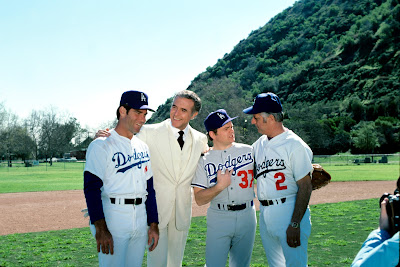
Here, Dodger great Don Drysdale compliments Greg’s slider, and from that moment nothing else matters to him but baseball. That life-plan proves short-lived after he gets clobbered in a Pony League game, leading to a final scene with Barry Williams and Robert Reed that is one of the more touching father-son moments on the series. 


Like Leo Durocher, Don Drysdale must have enjoyed doing guest spots. He also appeared in four episodes of The Donna Reed Show, as well as Leave it to Beaver and The Greatest American Hero.


1. “Baseball” (1979)

WKRP in Cincinnati

It’s always fun when a studio-bound series heads outside for a story, and that’s what happens in this episode written and directed by series creator Hugh Wilson. The softball game between rival radio stations WKRP and WPIG comprises most of the episode’s running time, and we get to see the entire cast hitting, pitching, and fielding. 


The climax hinges on whether nerdy newsman Les Nessman, who never played baseball growing up, can come through for his team in the ninth inning. I like his chances, but then I’m a Cubs fan – I always root for the underdog.

Wednesday, February 2, 2022

One Night, Two Dates: The Classic TV Teen Dilemma


When I was in high school, having two dates scheduled for the same night was the kind of dilemma with which I never had to contend. Just trying to get one date was challenge enough. But the kids on Comfort TV shows were better looking and more popular, so it’s not surprising that this situation occurs in more than one classic show. 


How do they get themselves into these messes, and how did they handle it? Let’s find out. For each show, our double-date protagonist has been given a rating of 1-10 on the two-timer scale: a one means they’re relatively blameless; a 10 means they definitely need a stern talking-to from mom and dad.


“The Rivals”

Father Knows Best

Poor Betty Anderson has fallen into a rut in her relationship with reliable old Ralph. Her flirty friend Marge (played by Barbara Eden!) is always flitting between a half dozen steady boyfriends and telling Betty how lucky she is that no other boys are interested in her. 


She probably meant that as a compliment.


But when they’re doubling at a diner one Saturday night Betty runs into Doyle Hobbs, who she met last summer while briefly working as an engineer on a survey crew (in an episode aired the previous season - a rare bit on continuity for this series). 


So to prove to Marge she can land another guy she accepts a date to a concert in the park – even though she already agreed to go with Ralph.


What makes “The Rivals” such a fun episode is how Betty’s parents react to her dilemma. Jim is disappointed that his daughter would be so devious, while Margaret thinks every girl should occasionally get to enjoy that kind of adoring attention. But while Betty decides how to resolve the situation, Doyle stops for gas where Ralph works and they get to talking about Saturday. The final scene is as unexpected as it is delightful.


Lots of star power in this episode: In addition to Barbara Eden, Doyle is played by Roger Smith, later of 77 Sunset Strip.


Two-Timer Ranking: 8


The impulse to impress Marge is understandable, but not resolving the situation, even on the day of the date, cannot be excused.


“Mary’s Double Date”

The Donna Reed Show

The day before the Junior Prom, Mary Stone has a decision to make: “Whether to let Phil take me or Ernie.” She plays them off each other like a symphony conductor, while simultaneously avoiding a third suitor, Charlie, whom she affectionately describes as her “door mat.”


She gets asked by both her choices, as expected, and doesn’t plan to let the loser know until 5pm on the day of the dance. But her comeuppance arrives before then, swift and severe and well deserved. “You played a dangerous game, and you lost,” Donna tells her, gently, “so no tears.” 


Two-Timer Ranking: 9


This episode is pure magic. Wonderfully written and endlessly quotable: “It’s wonderful to be attractive and popular, but you have to learn to use that power gently, and with kindness.” Its been nearly 40 years since I was in high school, and I still recall the names and faces of a couple of queen bees who failed to heed that advice. And some of those moments still sting.


“The Subject Was Noses”

The Brady Bunch

Marcia gets starry-eyed when big man on campus Doug Simpson asks for a date on Saturday night – then remembers she already has a date for Saturday with “plain, sweet, ordinary” Charlie. 


Predictably, like Molly Ringwald in Pretty in Pink she decides to stick with the handsome popular boy over his undersized rival. But unlike Betty Anderson and Mary Stone she at least has the good sense to not let the situation linger until the weekend. Greg offers sage advice – break the date with Charlie by using the lame but surprisingly effective excuse of “Something suddenly came up.” And it works, until karma arrives in the shape of a football that hits her in the face.


“The Subject Was Noses” certainly ranks as one of the most memorable series episodes, especially in how the tables are turned against Marcia when her same date-breaking excuse is used against her.


Two-Timer Ranking: 4


Marcia not only lets Charlie down easy, she apologizes for her deception and learns her lesson.


“Double Trouble”

The Partridge Family

Keith tries to get a date with gorgeous Joanna Hauser, aka “Miss Everything,” but she’s already going to the big beach party with her steady, who goes by the name “Spider.” Laurie offers to set him up with bookish Sally Winkler from the Shakespeare club. Keith reluctantly agrees, and then Spider’s plans change so Joanna is available again. Now he has two dates, but only wants one of them. “So what’s the problem?” Reuben asks. “Dump the nice one and go with the knockout!” No wonder he’s still single.


Instead, Keith fakes a cold to let Sally down easy – but fate has other plans.


Two-Timer Ranking: 2


Technically, Joanna became available before Laurie told Sally about the party, so he never should have been stuck with two dates in the first place. And while pretending to be sick is a pretty gutless solution, Joanna Hauser is played by Cheryl Ladd, so desperate measures in this case are more admissible. 


“Who’s Crazy Here?”

Eight is Enough


Tommy likes both Gretchen and Sherry, so he dates them both at the same time. “Don’t say I didn’t warn you,” cautions older brother David.


This is the B-story of the episode, so it doesn’t get as much screen time as Tom’s bout with insomnia and the misunderstandings it triggers.


Two-Timer Ranking: 6


Tommy avoids direct conflict by scheduling one date for 8pm and the other for 10pm, so here we have a case of breaking the spirit of the law more than the letter. But to expect two girls that attend the same high school to never figure out what’s happening explains why Tommy was never considered Honor Society material.


“Double Date”

Family Ties


Like Keith Partridge, Alex Keaton is turned down when he asks his dream girl to the senior prom, and then asks another girl instead. But then the first girl becomes available, and he decides to keep both dates. He devises a plan with the help of his friend Skippy:


Alex: “Okay, let's go over the plan once more. Now, the north end of the gym is now called...”


Skippy:  “Area "A".”


Alex: “Okay. At no point is Rachel to enter area "A" - prior to 8:57. Now - areas "B" and "D" are free zones which means... Either girl may enter provided the band is not on a break at the time. Now remember, when I'm with Rachel, I'm gonna be wearing the blue boutonniere. When I'm with Jocelyn - the red one. There are emergency exits at either end of the gymnasium. The master switch box is behind the blue wrestling mat. This will allow you to switch off the lights, lower the backboards, and in case of an emergency, open the floor over the swimming pool. Let's hope it doesn't come to that. 


Two-Timer Ranking: 10


“We’re going to make history,” Alex tells Skippy, but of course his arrogance proves his undoing. The dates in question were played by Jami Gertz and Daphne Zuniga, making this episode about as classic 1980s as you can get.


Wednesday, November 17, 2021

The Challenge of Three-Part Stories


I’ve done a few pieces about two-part episodes of classic shows and how, when they’re done right, they often rank among the most memorable entries from their respective series.


But it doesn’t happen all the time. Looking back it seems that for every successful two-part tale there is one that did not merit the extra running time, resulting in a story with superfluous subplots stretched with stock footage and other filler.


So if the track record for two-part stories is spotty, what must the verdict be for those with three parts?


Not as bad as you’d think, surprisingly. The reason, perhaps, being that many two-part shows start out as single episodes that get expanded somewhere along the way, while three-part stories are plotted from the beginning to fill a feature-length running time. The risk is in hoping viewers will return for all three installments. Today with DVRs that’s not an issue; but in the Comfort TV era before the VCR audiences had to watch the show when it was scheduled, so part one and part two better be intriguing enough to bring everyone back for the finale.


Here are six examples of shows that pulled it off – and one that did not.


The Hawaii Trilogy

The Brady Bunch

Travel is a common theme in these super-sized stories, and the Brady Bunch’s fourth season trip to Hawaii offers a prime example of how to do it right. From the beautiful beaches to the Pearl Harbor memorial, viewers enjoyed a virtual tropical vacation as the story unfolds. 


The final installment was certainly over-the-top for this series, with Vincent Price hamming it up as a paranoid archaeologist, but all is forgiven when he joins the family at the luau that ends their eventful trip. Replicas of the “tabu” idol Bobby finds at the construction site have become popular collectibles among Brady fans. 


Batman Vs. Lord Ffogg

Batman

Another travel adventure, as the Dynamic Duo visit “Londinium” after the mysterious thefts of historic treasures. But in this case there was no actual visit to London, which almost becomes a running joke within the story – witness the barely redressed set for Commissioner Gordon’s office serving as the office of Gordon’s British counterpart.


Batman deduces the guilty party within minutes of his arrival, suggesting the Londinium police are no more capable than those in Gotham City. It’s the infamous Lord Ffogg (Rudy Vallee) and Lady Penelope Peasoup (Glynis Johns), who run a school for shoplifters in training. This is one of the better third-season stories, and provides a better-than-usual showcase for Yvonne Craig’s Batgirl.  


“Lost in Spain”

Family Affair

One more travel story, as the Davis clan visits Spain, where a bus mix-up separates Buffy and Jody from Mr. French. It’s all shot on the studio backlot but it feels more authentic than many Europe-set shows, especially as the twins wander through the rural countryside while the rest of the family continue their desperate search. Eventually they find their way to a farmhouse, where the couple inside feeds them but is wary of reporting their location to the police. As always, Family Affair takes a more grounded and realistic approach to plots that have played out on dozens of other sitcoms, resulting in a story in which everyone’s fears feel more genuine, even though we know everything will end happily.


“Kill Oscar”

The Bionic Woman

This was the story that introduced the Fembots, which in the 1970s were popular enough to inspire their own action figures. No one who watched these shows first-run could forget when the Fembot’s face plate was removed, revealing electronics circuits and wires surrounding two creepy bulging eyes. 


The female robots were created by Dr. Franklin, a slightly mad scientist with a secret island base who plots to steal a device that can control the weather. That’s the kind of role that screams for a veteran scenery-chewer like Ross Martin – but instead they brought in the great John Houseman to give the part more gravitas –and it works. 


“Gold Train: The Bullet”

Gunsmoke

Matt has a bullet lodged near his spine, and Doc doesn’t want to risk performing an operation to remove it. They put the marshal on a train so he can see a specialist, and the train is held up by a gang led by guest star Eric Braeden. It took 17 seasons for this venerable western to serve up a three-part story, so no one should be surprised that it delivered plenty of action, drama and romance. Fans were delighted to see Milburn Stone return as Doc, after an extended absence following the actor’s bypass surgery. But the most memorable moment featured Amanda Blake, as Kitty (finally!) talks to Matt about the love she felt for him throughout the years.


A Man Called Smart

Get Smart

Of course you’ll want to watch all three parts of this story, which was originally intended for theatrical release. But it’s the first installment that features a masterpiece of slapstick comedy starring Don Adams, a stretcher and a revolving door. Adams, whose distinct voice and catchphrases were a big part of the show’s success, never utters a word throughout the sequence, and still earns huge laughs. There is also an innovative opening chase scene that portends Adams’ association with Inspector Gadget. 


The Falcon

Mission Impossible

Here’s the one that didn’t work, which isn’t surprising as Mission: Impossible also struggled with two-part stories. Fans already missing Martin Landau and Barbara Bain would have their patience with the series further tested by this bloated assignment: the team must stop a usurper’s plot to steal the throne of a princess. When M:I starts lifting plots from Disney, it’s not a good sign. 


Wednesday, September 29, 2021

Comfort TV Court – Three Memorable Cases


Any successful situation comedy will likely feature at least one episode set in a courtroom. The reasons are obvious:


1. It’s a familiar setting even for the non-felons in the viewing audience.


2. Conflict between characters drives narrative and intensifies audience interest – the courtroom provides a fitting backdrop for such conflicts.


3. Courtrooms are serious places, and thus ideal to have their solemn procedures upended with comic situations.

I thought about doing a top ten list of courtroom shows, but there are so many examples of this trope that an occasional series of pieces seemed like a better option. So let’s begin with three cases on our docket today. All rise!

Case #1: Duggan vs. Brady

The Brady Bunch


“The Fender Benders” opens after a vehicle accident in a supermarket parking lot. Viewers don’t get to see the crash – the episode opens with Carol and passengers Marcia, Bobby and Cindy returned home in their station wagon, which now sports a dented fender.


What should have been settled amicably escalates into a small-claims court case when Mr. Duggan (Jackie Coogan) gives Mr. Brady an exorbitant bill for $295.11 to cover the cost of car repairs.


Complicating matters is the fact that Bobby and Cindy suspect the accident was their mom’s fault – though Cindy is a known tattletale and Bobby once idolized outlaw Jesse James, so neither make particularly reliable witnesses.


Highlights: Mike reenacts the accident in the Brady driveway to determine who was at fault; Duggan’s courtroom entrance in a neck brace; the verdict triggered by a clever ploy by Mike that delivers one of the more surprising and satisfying climaxes to a Brady episode. 


Who’s that Judge?

Robert Emhardt, who also played judges on several other TV series from this era, including Medical Center and Police Story


Case #2: Petrie vs. Wiley

The Dick Van Dyke Show


In “The Case of the Pillows,” the Petries sue door-to-door salesman Wiley for $80, the price they paid for four pillows that were supposedly made from eiderdown, but were actually filled with, in Rob’s words, “cheap, chopped chicken feathers.”  


Highlights: The judge’s growing exasperation at Rob’s bumbling attempt to play Perry Mason (“Would the introduction of an indication of a misrepresentation be a substantiation?”; Alvy Moore as Wiley – he’s best known as Mr. Kimball on Green Acres, but here gets to channel his inner Mr. Haney. 


At one point, the judge refers to Mr. Petrie as “Mr. Preston,” a  joke I didn’t get until years later, when I realized it was a reference to Lawrence Preston on The Defenders.


Who’s that Judge?

It’s veteran character actor Ed Begley, who won an Academy Award in Sweet Bird of Youth, and was brilliant as a legal professor in an episode of The Fugitive entitled “Man in a Chariot.”


Case #3: The People vs. Addams

The Addams Family


Grandmama is arrested for illegal fortune telling, and is defended by Gomez.


Highlights: just about everything once court is in session. “The Addams Family in Court” is a great showcase for John Astin, and the courtroom provides a perfect backdrop for his wild-eyed, grandiose flights of rhetorical non-sequiturs.


Introduced by Morticia as “The bar’s brightest light, Gomez “Loophole” Addams,” he proceeds to baffle and frustrate the judge with inspired nonsense worthy of the Marx Brothers and the Three Stooges. This is definitely the funniest of the three cases on today’s docket. 


Who’s that Judge?

Hal Smith, aka Otis on The Andy Griffith Show and the Santa Claus that Cindy Brady asked to cure her mother’s laryngitis. He’s the perfect flustered straight man for Gomez, though it’s Morticia who finishes him off:


Judge: “In all my 30 years on the bench, I have never seen a more preposterous, idiotic, reprehensible display of court conduct.”


Morticia: “Well it did start that way, but you redeemed yourself.”


Until next time, court is adjourned.