Showing posts with label Room 222. Show all posts

Friday, April 22, 2022

The Ten Best Baseball-Themed Classic TV Episodes


Another baseball season is underway, and it doesn’t figure to be a memorable one for my Chicago Cubbies (though hope springs eternal as it always does in April). Every year around this time I like to pull out some baseball-themed episodes to get into the spirit, but I’ve never put together a list of my favorites – until now. 


Here, as Casey Kasem might say, is the Comfort TV countdown of the top ten baseball episodes from the classic television era.


10. “No Runs, No Hits, No Oysters” (1970)

The Ghost & Mrs. Muir

Young Jonathan wants to play shortstop for the Schooner Bay Oysters, but he can’t hit and he can’t field. The Captain offers supernatural assistance, but Mrs. Muir tells him her son should sink or swim on his own. I suppose there’s nothing that special about this episode, but I always welcome a chance to check in with a series I don’t revisit as often as I should. 


9. “Superstar” (1978)

Fantasy Island

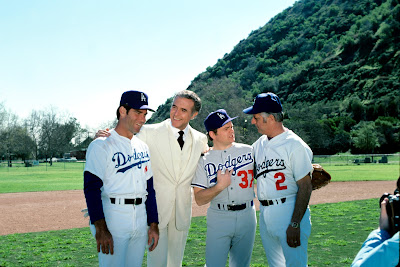
The fantasy of office drone Walter Delaney (Gary Burghoff) is to strike out three of baseball’s greatest stars. Mr. Roarke obliges, thanks to guest appearances from Steve Garvey, Fred Lynn, George Brett, Ken Brett, and Ellis Valentine, plus Dodgers manager Tommy Lasorda. It is interesting how professional sports, and baseball in particular, were incorporated more frequently and memorably into the TV shows of the Comfort TV era, as we’ll also see in other entries on this list. I’m not sure why that has changed; perhaps back them athletes recognized that sports should be viewed as entertainment nstead of just a business, and were more open to promoting that brand to the public. 


8. “The Strikeout King” (1973)

The Partridge Family

Danny has no interest in baseball but joins the local team because his mother thinks he should make more friends his own age. 


To his surprise he quickly becomes the team’s star pitcher – and starts to care more about winning the pennant than rehearsing in the garage. Also in this episode, Ricky Segall bleats out a song about Willie Mays – so have the mute button handy. 


7. “The National Pastime” (1961)

My Three Sons

Chip quits his little league team after striking out four times in the first game. He reconsiders later, a decision his father supports – but only to a point.


Chip:  “Will you talk to the coach?”

Dad: “No.”

Chip: “Will you come with me?”

Dad: “No.”

Chip: “Will you write him a note?”

Dad: “No.”


Chip’s coach doesn’t make it any easier – he asks Chip if he wants to be back on the team and Chip replies “I guess so,” “Well,” the coach replies, “when you’re done guessing and you’re sure, let me know.” By encouraging him to take full responsibility for his actions, the adults in Chip’s life are building character traits that will serve him well in the future.


6. “The Sound of a Different Drummer” (1976)

Shazam!

Curtis could be the star shortstop at Reseda High, but he quits the team because he’d rather play the violin and audition for the Inter-City Orchestra. 


His teammates don’t take kindly to that decision, and give him an ultimatum – either play baseball or they’ll grind his fiddle into toothpicks. Clearly this is the kind of serious dilemma that can only be solved by one of earth’s mightiest heroes. Thankfully, his RV just happened to be in the neighborhood at that time. Also pitching in – Maury Wills, one of baseball’s greatest base-stealers.


5. “Lucy and the Little League” (1963)

The Lucy Show

Just about every sitcom story about kids playing Little League will inevitably feature scenes of overzealous parents. Both Lucy and Viv fit that description here, harassing the team’s manager (William Schallert, always a welcome presence) and umpire until they are ordered to leave. Lucy devises a series of schemes to see her son play, in one of the series’ best first-season episodes.


4. “Jason and Big Mo”

Room 222 (1974)

Elmo (not the Muppet) is playing baseball at such a high level for Walt Whitman High that he already has offers from three Major League teams. With a big signing bonus on the table he’s ready to skip college and not even bother with a high school diploma, despite one of Pete Dixon’s typically eloquent lectures on the importance of education. Then Elmo wipes out on a motorbike and wrecks his knee, and the big league scouts stop calling. Elmo is well played by a pre-Hill Street Blues Michael Warren. This was the last episode of Room 222, ending the series just as it began, by telling important stories with intelligence and class.


3. “Leo Durocher Meets Mr. Ed” (1963)

Mr. Ed

Leo Durocher seemed to enjoy playing up his cantankerous image, as he does here and in episodes of The Beverly Hillbillies and The Munsters


But what makes this episode special is the appearance by Sandy Koufax, arguably one of the five best pitchers in baseball history. Vin Scully, who also appears in this episode, called him “the greatest pitcher (I’ve) ever seen.” But Ed wasn’t intimidated when he stepped into the box, bat in mouth, and drives a pitch off Koufax into deep left field, rounds the bases, and slides into home plate. 


Leo Durocher: “That’s the smartest horse I ever saw!”

Wilbur: “He’s not so smart. He forgot to touch second base.”


2. “The Dropout” (1970)

The Brady Bunch

There’s something about baseball that, more than any other sport, lends itself to stories of disappointment. As in the Ghost and Mrs. Muir episode, boys in the Comfort TV era felt a deeper sense of shame if they are less than proficient at our national pastime. Baseball has since lost viewers and youth interest to football, basketball and soccer, so that is likely no longer the case.


Here, Dodger great Don Drysdale compliments Greg’s slider, and from that moment nothing else matters to him but baseball. That life-plan proves short-lived after he gets clobbered in a Pony League game, leading to a final scene with Barry Williams and Robert Reed that is one of the more touching father-son moments on the series. 


Like Leo Durocher, Don Drysdale must have enjoyed doing guest spots. He also appeared in four episodes of The Donna Reed Show, as well as Leave it to Beaver and The Greatest American Hero.


1. “Baseball” (1979)

WKRP in Cincinnati

It’s always fun when a studio-bound series heads outside for a story, and that’s what happens in this episode written and directed by series creator Hugh Wilson. The softball game between rival radio stations WKRP and WPIG comprises most of the episode’s running time, and we get to see the entire cast hitting, pitching, and fielding. 


The climax hinges on whether nerdy newsman Les Nessman, who never played baseball growing up, can come through for his team in the ninth inning. I like his chances, but then I’m a Cubs fan – I always root for the underdog.

Monday, February 8, 2021

Censoring Classic TV

The other night I was watching an episode of Room 222 entitled “What Is a Man?”

The story opens with Alice (Karen Valentine) proposing a reading of Shakespeare’s Twelfth Night in the way it would be performed in Shakespeare’s day, with all the parts played by men. 


Howard, a student in the fine arts program, takes on one of the female roles and reads the lines with conviction the way any talented actor would.


But that performance, plus the fact that he’s not a good athlete and is shy around girls leads some of his male classmates to suspect he might be gay. That generates whispers in the hallway and some jokes in poor taste, culminating in a scene where Howard and Mr. Dixon (Lloyd Haynes) leave the classroom and notice a crowd around Howard’s locker.


Those gathered silently part, as Howard approaches his locker and sees a word scrawled on it by an unknown vandal. What did it say? I can make a guess, but that’s all I can do because the word was blurred out by the cable network Aspire TV.


How do you feel about that?


I’m tempted to stand up on an anti-censorship soapbox and rail against this current culture and its spoiled oversensitivity, and this ridiculous expectation that artistic works from decades ago must be altered to reflect the mindset of our more “enlightened” 21st century times.


But taking a scissors to art is nothing new, and did not start with the generation that invented safe spaces. For decades, when theatrical films aired on network television, profanity and scenes of nudity or extreme violence were altered or cut. When a television show goes into syndication, the full episode is routinely trimmed by a few minutes to accommodate more commercials.


Still, what happened with this Room 222 episode seems worse. This was not censorship required by FCC broadcast standards, or the result of economics. This was someone deciding they didn’t like that word, so no one should be allowed to see it.


It made no difference that the scene at Howard’s locker was intended to have a specific and powerful impact on those who watched it when it first aired 50 years ago. That word was there to jolt the viewer, especially at a time when any reference to homosexuality was still rare on network television. Within the context of that moment, blurring the word was a gross disservice to the episode’s creators, and to its audience. There was no plausible reason for it to happen. But it did.


And if you haven’t noticed, edits like this are becoming commonplace on cable networks like Aspire and MeTV. It’s a topic I discuss in a couple of places in my book When Television Brought Us Together. Whether it’s the Confederate flag on the roof of the General Lee in The Dukes of Hazzard, or a comedic take on characters of varying ethnicities on Get Smart, the shows of a bygone era are no longer deemed suitable for a general audience. 


I think it’s a disturbing trend, and one that gets worse the more it is tolerated. Words and symbols that almost everyone dislikes are always first to go, and then the movement expands to those that may not be as negative, but still don’t fit the agenda of those who wield the levers of cultural power.


Power – that’s what is almost always at the root of censorship. And it is almost always wrong. When art offers something uncomfortable, it should inspire a teaching moment, or an opportunity for discussion. When a series as progressive and inclusive and empathetic as Room 222 is deemed too offensive, that should be a sign that perhaps there is a better way to deal with situations like this. 


My suggestion: let “What Is a Man?” play unaltered, and air a parental guidance warning before it starts that the episode contains material that may be too mature for younger or more sensitive viewers. The easily triggered can then change the channel or proceed at their own risk.


This way, the station is absolved from having to decide what to air and what to cut – and that is as it should be. Purchasing the rights to broadcast a series should not come with the authority to deface it. When Room 222 is picked up by other cable stations, will they each get to make their own round of corrections? In another ten years there may not be enough left to fill a 30-minute time slot.


Van Gogh’s “Starry Night” hangs in New York’s Museum of Modern Art, but that doesn’t mean the curator should be allowed to remove a few swirls from the moonlit sky, because he thinks it looks better that way.


Leave our TV shows alone.

Monday, June 25, 2012

Grading TV's Teachers

 Many of us are drawn to certain TV shows because of common ground we share with their settings or characters. I have no doubt that doctors have greater insight into the scenarios created in Dr. Kildare, House and Marcus Welby, M.D., and may enjoy them (or dissect them) differently than I would.

For three years, I taught English 101 at a community college. While I did not have the dedication to continue in that pursuit, and have the greatest admiration for those that do, the experience has inspired an affinity for shows about teachers. I don’t think there’s been a school-set series from Our Miss Brooks to Glee that I haven’t at least sampled.

These are my five favorite TV teachers. I hope to hear about yours.

1. Pete Dixon (Lloyd Haynes), Room 222
Some pointy-headed social commentators enjoy pontificating about how bland television was back in the 1950s and 1960s, because it was unwilling or (due to tighter content standards) unable to explore “the real world.” And that since the 1980s, TV shows have become more “realistic,” and thus automatically better. This is largely nonsense, but that’s another topic for another day. It is relevant here because Room 222 (1969-1974) debuted in the midst of that perceived paradigm shift – it tackled real-world issues, yet still introduced in Pete Dixon a teacher as indisputably admirable as those educators from a more innocent era. 


As an American history teacher, Dixon challenged his students to question conventional wisdom. He encouraged classroom discussion, controversy and creativity; he fought the school administration when it was warranted, and backed them up when it was appropriate. And overworked as he was he wouldn’t let a kid fall through the cracks, no matter how much of his after-school time was compromised.

Best of all, he guided his students through a chaotic time by leading from an example of compassionate common sense that, had it been shared by more folks in 1969, might have eased some of the tensions that nearly broke the country in two. “I better ask you straight out – do you prefer ‘colored,’ or ‘negro,’ or ‘black’?” inquires naïve young student-teacher Alice Johnson (Karen Valentine). Responds Dixon, “I always preferred ‘Pete.’”

2. Elizabeth Sherwood (Carol Mayo Jenkins), Fame
Teaching has been called a thankless job, certainly when judged by its financial rewards. But what could be more thankless than teaching English in a school for the arts, where the students could care less about writing essays because they all expected to be in Hollywood or on Broadway in a few months? Such was the challenge met by Fame’s Elizabeth Sherwood. Sometimes she played their game, using Bob Dylan lyrics to teach a lesson in poetry; other times she force-fed them classic literature until they recognized its significance. And in one episode she performed a traditional African dance. Really, really badly.

3. Charlie Moore (Howard Hesseman), Head of the Class
The twist in this show was that the students on Head of the Class were the anti-Sweathogs, geniuses and super-achievers who were ostracized for their intelligence. Into this classroom of high-maintenance kids ambled Charlie Moore, the ultimate laid-back history professor who was not intimidated by the fact that his students were already smarter than he was. While this series doesn’t have A-list classic TV status, Howard Hesseman ranks on the short list of actors that played two noteworthy television characters. 


4. Professor Charles W. Kingsfield Jr. (John Houseman), The Paper Chase
Unlike the other teachers on this list, Professor Kingfield is one you’d love to watch on TV, but may hate to have standing at the business end of the classroom. Sure, years later you might look back with appreciation at how he turned your skull full of mush into the thoughts of a lawyer, but it was going to be hell getting there. The imperious John Houseman found a career-defining role after decades of prestigious work. And then he made Smith Barney the most respected investment firm on Wall Street. 


5. Miss McGinnis (Marion Ross), The Donna Reed Show
This is a one episode appearance (“Flowers for the Teacher,” season two), but it stuck with me because of how vividly it illustrates how terrified new teachers are when they stand in front of a classroom for the first time. Sure, you’ve got the bigger desk, but the power that comes with it is only an illusion. You’re outnumbered up there, and strong-arm tactics alone aren’t going to win the day. Fifteen years before Happy Days, Marion Ross is wonderful as a teacher fresh out of training school and still trying to figure out the job.

Honorable Mentions:
Jenny Calendar (Robia LaMorte), Buffy the Vampire Slayer
Russell Lawrence (Don Porter), Gidget
Albert Hague (Benjamin Shorofsky), Fame
Carrie Bliss (Hayley Mills), Good Morning Miss Bliss
Laura Jenkins (Peggy Lipton), Wings